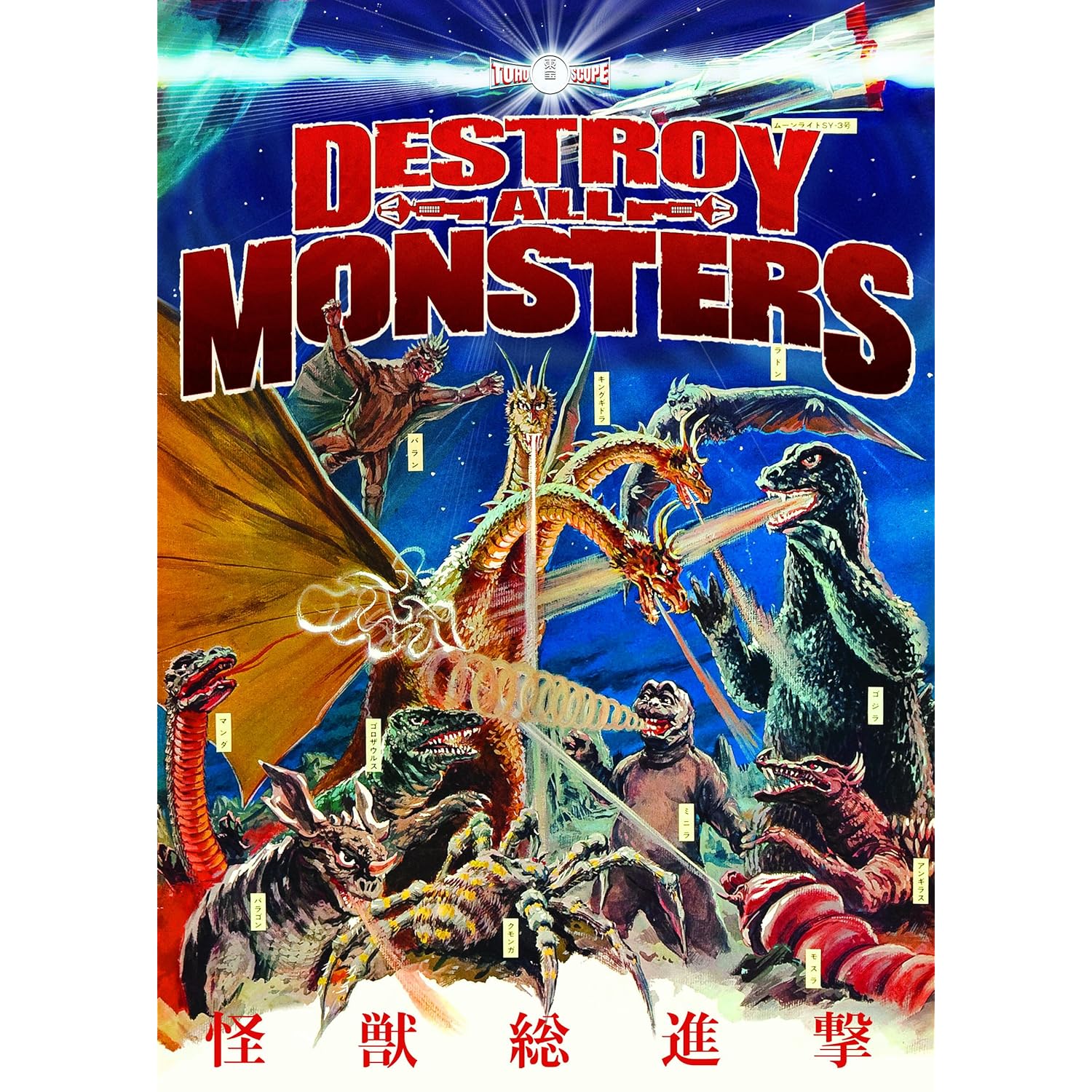
11.24.2011

DVD Review: Media Blaster's DESTROY ALL MONSTERS

Special Thanks to Lee Merritt, proprietor of Monsterland Forums for making this review possible.
.


This has been a great year for Godzilla fans. IDW doing three different lines of comic books, a good bit of DVD news, new board games, and a good bit of other stuff. The hottest topic would be the Media Blasters releases of DESTOROY ALL MONSTERS and GODZILLA VS. MEGALON. With DESTROY ALL MONSTERS being the less anticipated release, a good bit was still to be proven with it.
Video:
To set up a precedence, let’s go back to what James Ballard said when talking about the R2 DVD, which he gave 5/5 stars.


"As you would expect, Toho's domestic DVD release of "Destroy All Monsters" is once again a pinnacle in the line of kaiju releases. The video quite frankly looks like it could have been shot yesterday. As far as I could tell there was absolutely no print damage, bar some very tiny specks of dust in once scene, and no signs of digital artifacts. On occasion there is some light grain, but really only noticeable under close inspection. The film remains consistently sharp with lush and vivid colors. The film is presented in it's original widescreen ratio, and is enhanced for widescreen TV's."


With such a fine print used by Toho for their R2 DVD, and knowing that what Media Blasters has presented to us is the HD print which was a basic restoration of the film, should it be the perfect print? Considering that I own the DVD and now the blu-ray, I’d say this looks as great as it is going to look on DVD. Is there a general softness? Yes. Is the color platte not as vibrant as what one would assume? Yes. That is to be expected. Due to Toho's restoration being just a general clean up, colors are not going to be as vibrant as what it could have been back in '68 (it has been mentioend on the net that a better colored print of the film is out there somewhere). But this is the best this film is going to look on DVD unless Toho finds a full restoration neccessary, which is not the case.


In comparing with the ADV DVD, you can see a lot of what was wrong with the ADV print. The coloring of certain things is maybe better on the ADV DVD, such as the sky in the clip above but other than that, the ADV DVD has one of the worst problems with rainbows a film could have, with the moment something in the frame shows itself as white, rainbows appear. Another problem would be the lack of color correction, which you see the real colors here with the Media Blasters DVD.

Audio:
There are three audio tracks to the film, which the choices for the tracks are those which would be most relevant to American viewers. One Japanese track (2.0 and 4.1) and two English tracks (international and AIP).

Both Japanese and International tracks are on here and are flawless. They sound like any other audio tracks. Sure, it doesn’t stand out (though it may if you are watching this with a great set of earphones, which pretty much keep the sound waves up close to your ear drums therefore the dissipation of the sound waves isn’t a factor), but there isn’t problems really.


A big source of debate for this debate seems to be about the inclusion of the AIP dub, which should have been a great, great thing. For completists, the inclusion of both the international and AIP dubs makes the set feel more complete. Problem is that a cranking sound a long with some digital noise appears on the track (mostly in the beginning). You can tell that this is a problem that they tried to fix with the sections at the beginning being patched up via audio from another track, but the problems doesn’t last all that long. Still, a little imperfection could go a long way for some aficionados. Talk of an alternate source has been spread around, but that it couldn’t be used due to Toho granting permission to only use specific sources of materials for releases - one has to wonder what about other sources makes Toho not want to permit their participation (probably a matter of money).


Special Features:


In an interesting turn for the better, Media Blasters has chosen to do something a bit differently - the handling of special features. For past Toho titles, Media Blasters just copies what was on the R2 DVD releases. This time around, special features were brought onto the release which are not on the R2 DVD - a choice likely made because of the fact these are Godzilla films. Truth be told, Media Blasters is all too modest, for what is described on the back of their DVD cover for the film is truly an understatement.


The main attraction is the audio commentary by Steve Ryfle and Godziszewski. Plugging their book here and there, they do stay on topic of the film and having been doing research for their book, it helps a lot. A lot of details and trivia revolving around the film were made freshly known to me, such as the actor of a stage play being treated to seeing the kaiju and an actress from the film. The only downside would be that there are a couple of parts of the commentary where Ed and Steve’s voice could sound a bit more dynamic, making the commentary sound more enjoyable to the ears. Other than that, they do the same good word they did with the films they commented on for Classic Media.


Follow the yellow Japanese Characters


The DVD is filled to the brim with a bunch of trailers, with space being saved by compiling whole trailers into one video track. Least of which is the trailers for other Tokyo Shock/Media Blasters films including GODZILLA VS. MEGALON, DEATH KAPPA, FRANKENSTEIN CONQUERS THE WORLD, and (the brutally awesome) RIKI OH: THE STORY OF RICKY. Instead of having a page in which you can choose to watch each trailer separately, they are strung together like a little movie, though you can press the skip button on your remote to go to a specific trailer. Same thing is the matter with the "Promo Reel", which is the American trailer (in worse condition than what you can find on youtube), the Japanese, and French trailers for the films followed by four American radio spots. Also saving space by making it an easter egg rather start a new page for listing special features is the 8mm reel clips which feature AIP stuff on them. Not bad. So, let’s count that down - 4 non-DAM trailers, 3 DAM trailers, 4 Radio Spots, and 8mm movies. That’s 12 things right there.


The other special features consist of photo galleries - one being of posters for the film and another being for concept art and such. Both are great, though there is a case or two of repetition with the poster gallery. Regardless, both are great and it would be interesting to see these things on the blu-ray. In the meanwhile, the poster gallery just doesn’t show posters, but also theatrical programs (2 from 1972, 1 from 1968). It is a rather thorough gallery which non-Japanese readers can enjoy. It is great. It is even interesting to see stuff like Gappa being on DAM posters (like how Yonggary was on some German photobistura for GODZILLA VS. HEDORAH and a VHS for KING KONG VS. GODZILLA). But, the DVD gallery bit I felt was a bit much. But it’s inclusion on here I hope will mean that such a thing will be included on the GODZILLA VS. MEGALON DVD for the number of bootleg VHS tapes that film has endured is nothing less than legendary and would make a great gallery for the historian in all of us.


If there was one thing missing from the film - one single thing - it is not the inclusion of the international and AIP credit sequences (Which the blu-ray has and those who already have the ADV DVD and a connection or two already have), but something simple - really simple seeing how the cover for the tape that this was on was on the DVD gallery bit - the alternate and extended takes from the 1980’s Toho SFX Tape. That would have been some of the easiest things to put on the DVD. There is about 10-15 minutes of material, not much. But, at least we got some stuff which defiantly trumps any Japanese release.

Conclusion:
If this is a sample of things to come, I cannot say that I am not happy for what Megalon will bring. Great audio and visual content with a great bit of special features - particularly the concept art and story board galleries and the trailers/tv spots which are most interesting if only to get a glimpse at what the generation before us could have felt when they would watch these films at the cinemas nationwide in lieu of chance exhibitions at art house theatres. A great release which everyone should own. For an American release of a foreign film which is not being released by a big company, this is a spectacular release.


4.5/5

11.12.2011

Citizen Hyung Rae and the Death of Younggu-Art

The 1,000 words photos tell would show that like most buisness transactions, there is more than meets the eye.


For some of us, we like bad movies. Bad movies can be entertaining. Thus, even though it would be a small one, there was an audience for films like 2001 YONGGARY and D-WAR: DRAGON WARS. For those who are American, you might even have a taste for THE LAST GODFATHER, the only English-language entry of Shim Hyung Rae’s Younggu series.


Sadly, we might have seen the death of his brand of Korean cinema, meaning the possibility of no D-WAR 2, which some wanted to see. If you check, the official website has been shut down (the main Younggu-Art side along with the official D-WAR and 2001 YONGGARY sites).


Late October, it was reported that 43 employees of Shim Hung Rae’s company - Younggu-Art - were suing him for $790,000 in non-paid wages. It was to be paid with money received from the auctioning of the 1,655 square meter building which housed the company. The building was sold by Hyundai Swiss Mutual Savings Bank, (Younggu-Arts’ collateral security holder) and was bought by a developer - the only bidder. 3 month’s wages and 3 years severance pays would be paid through the profit made from the auction, with the rest going towards Shim‘s debts. Turns out Shim had borrowed 1.1 billion won against his company, something confirmed by the Financial Supervisory Service. This could be one of many tales of company funds being used inappropriately. Stories of gambling addiction revealed by former employees aren’t making things better.


Turns out that this is not the actual death of Younggu-Art. That happened back in 2009.


Back on July 19, 2009, Shim said he was shutting the firm down - claiming to be $36 million dollars (41 billion Korean Kwon by today‘s exchange rate) in debt. That isn’t the worse of his troubles. In May of 2009, Hyundai Savings Bank filed complaints in regards to 4 billion won in loans/interest. Four months later, a high court made it that Shim had to pay 2.5 billion won. The case is pending at the supreme court. In separate auctions, Shim’s two homes (one being a Hyundai apartment in Apgujeong-dong and another being a Tower Palace apartment in Dogok-dong) are being sold. One of them is 244 square meters in land area.


Shim’s fate just might be sealed when it came up that Shim was being investigated for illegal firearm remodeling. Even darker, claims have been made of Shim’s trying to influence political and business colleges via prostitution including what the Korean Herald said, "high-profile figures and young women" and even going as far as to deny investors refunds of investments back in Oct. 2009 with an illegally customized gas spray gun.


As of October 30, Shim Hyung Rae has been banned from leaving the country of South Korea. All allegations against Shim are said to have taken place from 2008-2011, the years in which Shim made THE LAST GODFATHER (Which failed at the box office in Korea and America) and was still producing MEMORY OF BREAD. Be watching, for SciFiJapan’s Korean correspondent Kim Song-Ho is to be writing a more in-depth article on this.


This is a sad day.


Sources:
http://www.koreaherald.com/national/Detail.jsp?newsMLId=20111023000245


http://news.asiaone.com/News/Latest%2BNews/Showbiz/Story/A1Story20111031-307891.html


http://english.chosun.com/site/data/html_dir/2011/11/01/2011110101160.html

10.24.2011

Film Review: HOKUSAI MANGA (1981)


NOTE: THE FOLLOWING BLOG POST CONTAINS ADULT MATERIAL. READER BEWARE. JOURNALISMG2KM, the KAIJU GALAXY COMMUNITY and ALL AFFILIATES ARE NOT RESPONSIBLE FOR ANYTHING NEGATIVE WHICH COMES FROM THIS POST.


For those who have pre-knowledge of this film and are feeling something akin to outrage or pure curiosity, you can find my explanation/reasoning at the end (this whole work is going to be divided into sections, so you can find easily at the end of the article). That being established, HOKUSAI MANGA is not one of the best films you’ll see but it has one of the better performances you will see from a Japanese film and is an interesting film overall.


SUMMARY
HOKUSAI MANGA is the story of Hokusai - the famous Japanese woodblock artist. It is not a strict biography now, for it does tell a story with a central theme and a study upon said theme. But this film is much like the 1984 film, AMADEUS. The film begins with Hokusai (going by his real name at the time), enjoying a bath along with friends who would later become great artists in their own right (like the novelist Bakin). Hokusai shows that he has an ambition - to become a great artist (and not just a woodblock artist at that). His work initially seen as crummy. With the subject of many of his works being women - both clothed and nude - no one sees any value in them. It is called just pornographic abroad and his daughter sees them as too "logical", hence boring. This is a tough pill to swallow due to the fact that he dare get disowned by his father (who was a mirror-cleaning shogunate) just to learn to paint.


It is only when he meets his muse (a woman named Onao) does he start painting for real. Many events happen which are indirectly caused by the muse, and she eventually leaves. But once one of his paintings is sold to a publishing company, Hokusai becomes famous, doing paintings of cranes on rice, painting on large dining room-sized canvases, and even drawing Mt. Fuji from 30 plus angles at different times of day. We skip to the latter part of his life where he and his friend, Bakin, are old men. It is durring this time that Hokusai learns how to do tasteful nudes with substance.


This is one of the 36 VIEWS OF FUJI, this one specificaly shown in the film.


ANALYSIS
HOKUSAI MANGA has a point within it. It is all about women. Mostly because women are men’s muses. So, upon closer observation, this film has to do with the muse-artist relationship. A muse is an important thing to the artist (no matter what medium). It is the muse which literally makes a work "inspired". It is something they can rely on. Persistence. In that reliance, there’s something (their work) which can keep their memory going for years after they have gone. There is a scene in the film in which before the writer Bakin becomes a widower, his passing wife finally allows him to become a writer. That is who he is meant to be. As the writer Harlan Ellison said, " Posterity is the only reason to do this." (Harlan was talking about writing, but writing is an art form just as much as painting or directing).


But, there is something interesting in the muse/artist relationship. It is the sexual side of things. Most of the time, especially with male artists, their muse is a female figure of some sort. That, mixed in with a message of what a tasteful nude is, is what this film is all about. As the film shows, those who aspire to draw tasteful nudes have quite a way to go. The film shows that at the beginning of his career, Hokusai did paint nudes but they were disregarded as pornography. It is only later down on in life in which Hokusai gets the perspective in which he could do tasteful nudes such as THE FISHERMAN’S WIFE.


That is a battle of the human intellectual adaptation versus the natural animalistic instincts. When you are young, you lack insight and the animalistic side of you is king. This is shown to great detail as Hokusai’s father, who was strongly attracted to his son’s muse, ended up hanging himself just because he wouldn’t be with the woman. The sexual want is just too much. But with time, things get clear. It is because of this that most of Hokusai’s life from his late thirties to his late eighties were ignored. A good artist has perspective, and he gained it. That perspective is to illustrate the desires of a woman. Not to be pornographic but to shed light on a world untouched. To explore the world of womanly desires was a new idea back in Elden Japan. Japan was largely a male-centered country with a male-centered culture, thus to put such interest and care into what a woman’s interest is quite the perspective. Not to mention that the study of this kind of emotion is what Hokusai needed because while his early work was too logical, work like THE FISHERMAN’S WIFE is just the opposite because it deals with the most illogical thing around - human emotion.


Sad thing is that younger people may often confuse the two, art and pornography. Having done THE FISHERMAN’S WIFE later on in life with a new woman who looked like Onao, Hokusai was old but his new model quite young. She became admiring of Hokusai’s odd artistic choices but she showed that she didn’t understand his work. At her last appearance in the film, the new model starts having sex with a man. Just regular sex. Hokusai walks in on it and when she asks if he is excited and wanted to paint her in the act, he declined. She didn’t understand it and goes off.


For all of that above, this film cannot be called pornographic. There is a literal art to it. There is less than 20 minutes of nudity within the whole film (which is an hour 58 minutes long). To call this film pornographic would be like calling Stanley Kubrick’s EYES WIDE SHUT pornographic.


Ken Ogata is, to Western audiences, best known for the 1980's Paul Schrader film based on another famous Japanese artist (one of the liturate field), MISHIMA.

As far as direction goes, the film’s direction by Kaneto Shindo (who also wrote the film) is nothing too spectacular for a Japanese film. It is notable though, particularly with this reviewer, that it was this film which finally made me realize why Japanese films linger with long takes of scenes with no camera movement. It makes it seem like you are watching a play. This is quite remarkable. Though the make up of the film isn’t anything that will make you think of Kabuki or Noh theatre (rather, the make up at the end is applied to the actors just to show a difference in age), it is an interesting perspective to put the audience in. It is stuff like this which helps makes scenes like a monologue by Ken Ogata (playing the elderly Hokusai) gain momentum by not only being potentially interpreted as a personal diary said aloud to himself, but also as a monologue he is saying to the audience directly. It is almost like a moment out of GOODFELLAS.


Now, this is an interesting piece to choose to review for a blog like this. Truth is, there is one shot that could be called tokusatsu. The particular scene which enacts the inspiration Hokusai gets to draw THE FISHERMAN’S WIFE is done via both a real life enactment and a showing of what is going on within Hokusai’s head. The two wire-clad Octopi props and such were done by a notable person who has worked within the realm of kaiju eiga before - and with this being a Shochiku film, it is only natural that the art direction and possible doing of special effects be done by Shigemori Shigeta - award winning art director for SPACE MONSTER GUILALA and THE LAST SAMURAI. It’s not the best scene (there is a wire visible in one shot) but it is an interesting look into the mind of the master artist. While the kaiju connection is being discussed, it is notable that one of Hokusai’s works was used at the end of a Godzilla movie, Banno’s GODZILLA VS. HEDORAH.


Bottom line, it is a well written film with pretty good directing with the strong point being Ken Ogata’s acting. For some, recognizing the renown actor may be easy, for me it was difficult being used to only seeing him play Miyamoto Musashi (which required a good bit of make-up) in MAKAI TENSHO. It is an interesting look at the life of an artist and a nice way to spend two hours. Just be prepared for laughable content (the octopus scene might look fake to some and due to Japan’s censorship laws in regards to nudity in film and art (which proclaims that genitalia is not allowed to go uncensored in any form of media) the strains in which the filmmakers try to cover up body parts might seem a little obvious if not desperate). This film is worthy of all the awards it won and was nominated for back in 1981.


Recognize this GODZILLA VS. HEDORAH fans?


For those interested in seeing the film IMDB has it avaliable legally via Hulu.

http://www.imdb.com/video/hulu/vi1140824857


REASON
Those who wonder as to why I chose to review such a film on this site, you shall have your curiosity quenched. Going through youtube one night, I stumbled upon a clip of the octopus scene from the film posted. I was curious and once I saw the period piece setting and the fact there was a painter by the woman who had a octopus on her, I knew what it was right then and there (the things they teach you in 7th grade art class). Oddly enough, someone was going through my likes list and decided to flame bait myself. People assumed that I had liked the clip due to it being sexual in nature thus it was purely pornographic (though none of these individuals have seen the film), that I was not allowed to press the like button on such things (just because my channel’s content is that of which minors may look at), and that even if I liked the clip for it’s artistic merits, that was not the case for some claim they know me so well that it wasn’t the case.


Truth is, it wasn’t the case. I did like it for it’s artistic merits. It wasn’t pornographic, and in all reality just because the film is called EDO PORN in America doesn’t mean anything. It is a bad, inaccurate title for a Japanese film (and this isn’t the first time something like this has happened, anyone remember GODZILLA VS. THE THING or GODZILLA ON MONSTER ISLAND) that isn’t about porn (and someone tried to use the inaccurate title as something against me, going as far as calling me a dumb f***).


I hope this clears stuff up. I was in the right and this is a film I would prefer. Watch and don’t judge. And I don’t care if Children watch.

10.16.2011

JG2KM Reaction to Criterion GODZILLA DVD

Criterion's DVD cover was met with critisism, but was generally approved of.


Recently, Criterion surprised all of us in the evening a couple of days ago when we found their official page for their release of the first Godzilla film, a film they leased out from Classic Media (who released their own 2 disc version of it). So, what do we make of this news? The news of what special features will be part of the set coupled with a release date which is very, very close by (January 2012)? Well, let’s see…


First, let’s go through the special features. Both versions of Godzilla are getting an audio commentary by author David Kalat. Kalat is one of the more known writers on the Godzilla film. His most notable work is that of A CRITICAL HISTORY AND FILMOGRAPHY OF TOHO’S GODZILLA SERIES (with the original version being the best, the updated version was not well received for it’s cutting back on information to make room for the Millennium series of Godzilla films). His work, while containing some factual information about the production of each film, the manifesto does try to center itself on the subtext, meanings, and interpretations of the films.


This isn’t the first time that Kalat has done a Godzilla commentary though. He was employed by Classic Media to do the audio commentary for GHIDORAH, THE THREE HEADED MONSTER. Reviews criticized him for going off topic (no matter how informational he may be) and making simple errors in the form of generalizations. But he did make an impression as being quite enthusiastic about his work, thus he is regarded by some as a favorite.


Luckily, we can see to an extent what he is going to talk about in the commentary by viewing his book. For those who do not own his book, refer to it here:
http://books.google.com/books?id=9QyaTVYvEPQC&printsec=frontcover&dq=a+critical+history+and+filmography+of+toho


However, particularly when it comes down to the commentary for GODZILLA, KING OF THE MONSTERS, one cannot think that Kalat can out-do the Godziszewski/Ryfle commentary track. When the duo provided audio clips of interviews from people involved, there is next to no topping that unless he is allowed to borrow the audio clips for his own use.


Next, and this is easily the most important feature on the set, will be newly filmed interviews, particularly with effects technicians Yoshio Irie and Eizo Kaimai. This is most interesting, and one has to wonder about these individuals. When doing an IMDB search, we see that Eizo Kaimai was a person who had worked on Honda’s THE H-MAN while Yoshio Irie (unless there are two of them and IMDB doesn’t have a profile of an older Irie) is a fairly new guy, having worked on titles such as 2008’s ICHI... or so you would have thought! Thanks to Brett Homenick bringing this to my attention, turns out Irie is no stranger to interviews, including one which was done with some of the fore-fathers of the G-FAN/Kaiju Fan fanzines.


http://www.historyvortex.org/InterviewYoshioIrie.html


Next which caught my eye was the "New interview with Japanese-film critic Tadao Sato". This is a new name, at least to me anyway. According to Wikipedia, Tadao "is a prominent Japanese film critic and film theorist. Satō has published more than 30 books on film, and is one of the foremost scholars and historians addressing Japanese film, though little of his work has been translated for publication abroad." This is something which I am really interested in because - most for - the fact that the cultural barrier between America and Japan is such that there is a good bit more American audiences who are going to buy this title can learn. An interesting bit of which is a Japanese view of Godzilla which some claim was only around when GMK (2001) was made that Godzilla was a representation of souls lost in the Pacific theatre of WWII. However, writers like Norio Akasaka wrote that Godzilla was a, "representation of the spirits of soldiers who died in the South Pacific durring the Second World War… after coming from the South Pacific to destroy of the Ginza and the Diet building, Godzilla stops suddenly in front of the Imperial Palace, then turns his head right and heads back out to sea with this look of painful sadness on his face", and Akasaka would go on to compare Godzilla to a story by the famous Yukio Mishima (who Paul Schrader made a film about) which critique’s Japan’s moral after the world. More of this kind of material would be nice to hear, hopefully adding freshness to the usual "Godzilla is an allegory for the bomb" which long time fans may be all too used to.


You got William Tsutsui who works at a university in Texas... then you got Gred Pflugfelder who works at the New York-based Columbia University. Now, giving the set something which the British Film Institute product had which the Classic Media release didn’t have was a feature on the Fukuryu Maru AKA the Lucky Dragon No. 5. However, instead of recycling the BFI feature, Criterion decided to have Greg Pflugfelder(Director of the Donald Keene Center of Japanese Culture at Columbia University) do a feature titled THE UNLUCKIEST DRAGON (which sounds like a twisted version of a film children would watch) based on the Lucky Dragon No. 5 incident which was one of the three main inspirations for GODZILLA. He's notable for having done a Godzila exhibit back in 2004 in New York. Here is a link to his page: http://www.columbia.edu/cu/weai/faculty/pflugfelder.html


The last interesting thing is an essay done by J. Hoberman. A critic who works right now as a senior critic for THE VILLAGE VOICE, this BA and MFA-holding film critics might just be the most interesting person giving a kind of contribution as far as non-Asian contributors are concerned for Hoberman is 63 years old - he was eight years old when GKOTM was released into American theatres, 11 when GIGANTIS, THE FIRE MONSTER was released, so on, so forth. He might just have insight which is most interesting being older than Godzilla himself!


There are other special features on the set. Newly done subtitles which will hopefully give us the most accurate translation of the film since the legendary 1980’s bootleg tape, an interview with Akira Ifukube most likely ported from the R2 DVD set, and a mysterious featurette on the film’s photographic effects which I don’t know what to make of it right now (could be something newly produced or something which Criterion has loaned from Toho or maybe Classic Media?).


Can this be the definitive release of GODZILLA? When comparing it to the other releases, it might be film and special features wise. We’ll just have to wait and see.

10.13.2011

Tomoo Hariguchi's Prop Collection

Many of us may see a picture of Toho's prop storage facility only to feel saddened that they are not keeping up with props, which seems weird thus the props are rotting and withering away and since they don't do anything with them, it is kind of a waste of space. But enter the lucky fan like Ed Godziszewski or the late owner of Monster Zero Information Site who might have a claw or a dorsal fin of a suit. Good, but those are only parts. To the rescue is some of the the special effects artists of kaiju eiga. Koichi Kawakita has his collection of props and such, but today, we are going to see through the lense of a camera owned by Japanophile Patrick Macias the prop collection of Tomoo Hariguchi. Some stuff will surprise you. Take a look!

7.30.2011

IDW G:KOM Issue 2 Review


By Donny Winter


IDW Publishing’s next issue of GODZILLA: KINGDOM OF MONSTERS is definitely a step up from its first installment. While one of my main complaints during the first issue was the apparent instability in the characters not to mention some inconsistencies with art, Issue 2 definitely improves in both regards.


Immediately the second issue starts out with a Godzilla attack on Japan interweaved with various appearances in different settings--the main focus a man who is searching for his missing children. This man is actually one of the more interesting characters who’s appeared in the series up to date, and he’s seen all the way through the end of the issue. Secondly, not only do more fascinating human characters surface, but both Rodan and Anguirus appear in the story introduced by the death of animals and pestilence--providing a better sense of that apocalyptic feeling that really wasn’t evident in the first issue.


Issue 2 is not perfect, it does have its faults. At times the artistic impressions of the kaiju, most notably Anguirus seem a bit off. There are instances where he seems to look like he does in the movies, and there are other scenes where he seems to look more like a dog than a reptile. Other than that, both Rodan and Godzilla have very detailed representations.


Much like the previous issue, Issue 2 contains a significant amount of political nuance and we get to see frequent appearances from President Obama and the Governor of Texas. Naturally there is a bit of humor accompanied by these political figures, mainly the Texan Governor state wild radical notions toward the monster threat occurring in his state. Hopefully these political threads will continue to flow into future issues. Overall, while Issue 2 seemed a bit rushed when introducing the secondary kaiju characters and the inconsistent artistic impressions of Anguirus, it is quite superior to the introduction to this comic book series. The human characters are much more developed, and the build up toward the climatic monster appearances, while fast-paced, are pretty epic.


Definitely a worthy second installment to this series.


7.04.2011

Japan's Celebration of MOTHRA's 50th Anniversary


With Mothra’s 50th anniversary coming up soon (July 30th), the Queen of the Monsters (an official title used on the deluxe laserdisc set for 1996’s REBIRTH OF MOTHRA) is enjoying some recognition of the occasion. First to mention is that the Humax Cinema theatre in Japan is hosting a triple feature of Mothra films. The first is the original MOTHRA, which not only was one of the biggest hits Toho had for a monster film but would have the basic formula rehashed in Mothra’s 1964 (Mvs.G) and 1992 outings. Next would be GODZILLA, MOTHRA, EBIRAH: BIG DUEL IN THE SOUTH SEA, a film which focused more on the natives of Infant Island and their being enslaved. Then we have Mothra’s 1996 trilogy-starter REBIRTH OF MOTHRA, which took Mothra’s nature loving attitude to a new level and was one of Koichi Kawakita’s final feature length films in which he was the director of special effects. This triple feature shall be showing on July 30th. For more information, check out the links below.


http://www.humax-cinema.co.jp/cinema/special/meigaza/img/mothra.pdf
http://www.humax-cinema.co.jp/index.html


We here at the KG community wish Mothra a happy 50th anniversary. Don’t forget that the Starz channels are showing the Mothra trilogy along with GODZILLA, MOTHRA, KING GHIDORAH: GIANT MONSTERS ALL OUT ATTACK.

6.24.2011

6.21.2011

Trip Down Memory Lane - tokyomonsters.com

Believe it or not, I took this screen cap today.


To many tokusatsu otaku out there, this was one of the best sites you could go to. For me, between Tohokingdom's DVD section, DigitalMonsterIsland, and this site, this was the best of them. This was a site which taught me and a lot of other fans bits and more about not only kaiju eiga but also the many DVDs that were out at the time of these films and shows that we love so much. This is James Ballard's Tokyo Monsters, the premeir site for DVD reviews of most regions.


This site was important for numerous reasons. First and foremost, informative reviews of the films' DVD releases were some of the most detailed, both in text and in pictures. Second, it helped teach me (and some other people for sure) about DVDs and the terminology that went along with them. Third, the site was most important in that for download were subtitles for most R2 kaiju DVDs as well as a good bit of the R1 DVDs. These subtitles are painstaking works by bilingual fans for films released in America with dubtitles (GMK anyone?).


The important thing is that the site is not at all gone. Though the site has been let go of and, under normal circumstances not accessible. However, it has been archived. Here is a link:


It is not easy internet surfing, let me assure you. There is some times in which you would have to actually change stuff in the url address yourself to get to things like the Region 2 and region 1 DVD reviews, but that shouldn't be too much of a problem. TokyoMonsters is still around thus I hope you will enjoy it.