Showing posts with label Review. Show all posts

2.08.2010

Satomi Hakken Den (1983)


My favorite sub-genre in all of tokusatsu eiga would have to be the films dealing with Japanese mythology. In this genre, I have two supreme favorites: "Gamera 3: Incomplete Struggle" (1999) and "Satomi Hakken Den" (1983). Here is a breakdown of the film's production. As a reminder to the reader, tokusatsu eiga does not only surround kaiju, but all Japanese special effects films.


Kinji Fukasaku. His name is one of the most popular in all of Nippon Eiga. He is almost up there with Akira Kurosawa. After going through the 1970’s doing mostly Yakuza films, Fukasaku turned his attention to tokusatsu eiga. This included films like "The Green Slime" and "Message In Space". The mentioning of the latter film is important for it is one of the things that is part of the Kinji Fukasaku image people have. It is that "Message In Space" is actually based on the same story that "Satomi Hakken Den" was based on: "The Hakken Den". Technically, while "Message From Space" is influenced from the real "Hakkenden" by Balkin, this film is actually a film adaptation of a modern adaptation, called "New Satomi Hakken Den" written by Toshiro Kamata. Fukasaku, who was given a rough copy of the book that was to be published by Kadokawa, used it as a scapegoat from having to adapt the gargantuan epic which is the original "Satomi Hakken Den". The novel was hastily finished for the film's released, so says Fukasaku. "I was really impressed that they had the novel ready to be turned into a movie that fast." This would be the second cinematic adaptation of "The Hakkenden" tale, and would be a continuation of Fukasaku's "New Jidai Geki" ("New Period Piece Film").


Producing the film would be mega producer (in the same vein as America's Harvey Weinstein) Haruki Kadokawa, who worked with Fukasaku on "Makai Tensho" and owned the Kadokawa film company until being caught with possession of cocaine in 1993. The use of Kadokawa would be something of a necessity, since "Satomi Hakken Den" is a film on similar scale to one of Haruki’s own films, "Heaven and Earth" (mentioned in the Chapter 1), therefore needed a large publicity stunt. The film was budgeted over a million US dollars, a rare feat at the time. The screenplay was written by both Kinji Fukasaku and Toshio Kamata.


The actors in the film included people Fukasaku already worked with. From the Japan Action Club came the famous Sonny Chiba (Kill Bill, Vol. 1; Street Fighter) and his partner, a young Hiroyuki Sanada (Onmyoji, Rush Hour 3, The Last Samurai). Both worked on Fukasaku’s 1981 film "Makai Tensho" (Samurai Reincarnation) and Chiba starred in an earlier Fukasaku film playing the same character of Jubei in "Shogun’s Samurai". However, unlike the previous films, Sonny Chiba would be more of a supporting actor with Haryuki Sanada being the lead actor and potential love interest in the film and top actor. Opposite of Sanada is Hiroko Yakushimaru, a film star and pop idol at the time of the film’s production and future actress in Toho’s first "ALWAYS" film. Her stardom came from not only this film but also another film released also in 1981, "Sailor Suit and Machine Gun" (which Kadokawa was behind). "She was 19 years old when we were filming Eight Samurai. She was studying for her college exam the whole time." Together, they had great on screen chemistry. "I knew if we put these two idols in a strange time period and setting, we'd end up with a really special kind of film."


The score of the film, though composed mainly by the band "Nobody" was produced in conjunction with American soft rock singer John O’Banion. O’Banion recorded accouple of songs for the film, including "White Light" and "I Don’t Want This Night To End" (which two different but very similar mixed appear in the film). His appeal came from the fact that O’Banion’s previous song, "I Don’t Want to Loose Your Love" was awarded at the Tokyo Music Festival. The usage of such scores became a regular thing in Japan, even effecting Toho's Godzilla reboot, "The Return of Godzilla". Two separate soundtracks to the film were released for the film, one with the film’s score and the other with O’Banion’s contributions to the film. The difference between the two was that O’Banion’s had at the bottom a painting of the Virgin Mary and Jesus overlapping the theatrical poster art for the film.


The film would be released in roadshow (this means that it played in sections of Japan, for example, it would play in the Kyoto region for some time before moving on to Osaka and then Tokyo) December 10, 1983. It’s publicity - with some snuck in claims of the film taking 10 years to make - was something of genius for it was one of the biggest box office hits of that year. Something done to increase sales was that after a section of Japan had the film played, the VHS was available for public consumption. These tapes had cost well over $100, but it wasn't a problem and over 50,000 people bought the tape.


However, English speaking territories like America were out of luck with the film receiving little to no attention, especially with the international trailer using two different names for the film, "Legend of the Eight Samurai" and "Legend of the Eight Ninjas". Like some films, the international version of the film fell into public domain and though now officially released in America is still largely bootlegged.

1.30.2010

Review: "Gehara: The Long And Dark Haired Monster"


^The closest thing to "Gehara, Garemon, Giant Robot: Japan SOS" we will ever get.

The last of the kaiju films I have been meaning to review for a while is "Gehara" or as the legal title is, "Geharha" (though if that was the actual translation, then Godzilla would be Gojirha). Technically, I am re-reviewing it. The original review didn’t survive the blog transition so here we are. So, since most have already seen the film, I am going to skip to the review. Though I should mention, it is awesome finally seeing the film subtitled.

This film is one of two films Kiyotaka Taguchi directed in 2008/2009. The other is "G". Though this film is vastly more superior to "G" in every way. Now sure, Shinji Higuchi was on board for the SFX work here, but I am talking about other things. "G" was directed in a very erratic sense. "Gehara" isn’t and for good reason. With this we do not waste the talents of Shiro Sano, a Godzilla veteran. With this, we get a more traditional and well rounded kaiju film. Gone is the gore and nut shots of "G". Instead, this film is just one big tribute. From the Ifukube music to the "Ultraman", "War of the Gargantuas", and "Mysterians" and other reverences to the ending which is inspired - if not copied - from Takeshi Shimura’s final lines from the original "Gojira", this is a cool kaiju short that pulls out all of the stops, including bringing on destruction a single kaiju hasn’t brought on since "Gamera 2: Advent of Legion".

Now we can just hope that the faux trailer for "Gehara: Monster Martial Law" isn’t as faux as some think it is.
Score: 4.7/5

Review: "Deep Sea Monster Reigo vs. The Battleship Yamato"


Shinpei Hayashida. It is sad that not too many people in the fandom know his name by heart. Sure, they know about his most famous film - "Gamera 4: Truth" - but sadly, they do not know too much about him and his other works. Here is one thing about him: he is a major kaiju fan. He has made a fan film on Godzilla before he did one on Gamera. Another thing is that Shinpei: he is skilled in rakugo. These factors, put together, is some of the reasons why "Deep Sea Monster Reigo vs. The Battleship Yamato" works and even has an edge of originally against it’s amateur CGI work. Again, I saw this film un subtitled so I relied on SciFiJapan to help me out here.

The story is an untold chapter of the legendary Yamato battleship’s short story. Human wise, the story is set around Yukijiro Hotaru‘s character, a navy commander of some sort and the young Taiyo Sugiura’s character. Yukijiro is playing a character far from the Mr. Osako we know him of the Gamera trilogy. This character is crude and perverted while trying to deal with a creepy encounter with an old man who tells him the legend of Reigo. Taiyo Sugiura is the love interested of the story. A pretty boy, he is one of the young men sent out, leaving his mother and childhood sweet heart behind. The movie revolves around those two characters.

Now, time for the review. The SFX are something that need to be discussed first since many people have taken note of them. Now, the fact that this film is a collaboration of Tomoo Hariguchi (of Gamera 3 and Death Kappa fame) and Keita Amemiya (I have no idea what he has done) has been publicized as a big deal is not a factor here. I mean, even Shinichi Wasaka worked on the film (I am watching the making of segment when they are painting the Bonefish props and I have seen Wasaka on screen accouple of times along with the Finaro-Goji suit). But I bet due to it’s low budget, CGI was used. And those thinking that YONGGARY was bad needs to think again. Though I liked this film, I have no doubts that the CGI usage will drive some American tokusatsu otaku away from this production. Though the puppets and models are some of the most detailed I have seen, the CGI battleships and ocean scenery are a turn off. Watcher be aware.

I do not know who directed the SFX model-wise, but I got three guesses: Kazuaki Skiyama, Katsuo Kawazoe, or Hajime Matsumoto. Maybe all three did their own parts of the SFX shots. However, the direction with the SFX is very nice. Some moments are a little questionable, like why they chose to shoot the scene with the bonefish the way they did, but there are some awesome shots. Such is one of Reigo rising out of the water, does a turn in the air, and goes back down in the water. The little maneuver take a little off the Yamato’s top and causes a little explosion. It is like a Matrix-kaiju scene done right. Some explosion scenes are also done beautifully. Another beautiful shot is when Reigo first comes up out of the water full body. SciFiJapan actually has this scenes broken down frame by frame in their coverage of the film. I suggest you go see it.

The directorial style of the human scenes is good. But it is nothing too special. It is nice to see some black and white scenes through the film, but overall it is nothing too special. The plot is executed well though. The romantic side of the story is executed well, enough to touch a person emotionally. The comedy bits are good enough to make you laugh with it, even without subtitles. And Hayashida’s experience in rakugo shows, especially in the end with Hayashida showing his version of the Yamato’s downfall, which includes a cameo by famous Kabuki performer Ukon Ichikawa. The downfall of the Yamato battle ship is something which obviously is something very spiritual and that is captured completely.

Overall, unless you see it subtitled, I see a lot of kaiju fans not wanting to take the time to watch this film. And it is sad since it is a good film. There really is no reason why NOT to watch the film. It is one of the more original kaiju films that has NOT been made by anyone named Kaneko or Higuchi in a long time - in fact, it is one of the best since Biollante. But of course this film is not as good as GMK. But it is defiantly worth a watch.

Score: 4/5

1.27.2010

Review: "G"


Special Thanks to my friend Keith for making this review possible

One of the reasons why people love the Showa series is because of the amount of "variety" the series had, mostly from the fact that over seven kaiju had their premiers in the Showa series with their own film or television series. Even Toei did one with Dragons and such. Hell, make it 8 if one wants to remember "Agon, The Atomic Dragon". And there’s even more with that, if you count the other non-Goji kaiju films Honda directed and Tsuburaya did the SFX for ("Dogora" and "Yog" I think Nakano did though). But you get my point. Now, that trend was abandoned in the Heisei series. The only kaiju which got their own films are Godzilla, Gamera, and Mothra with Yamato-No-Orochi appearing once in 1994. But now with the Millennium series going underway, we got the variety trend going on again. It’s mostly because of this digital age which makes making films a lot easier. With this, kaiju eiga is not filled with only Gamera/Godzilla/Ultraman films anymore. There is now a growing series of independent kaiju films being made. Not including "Gamera 4: Truth", "Negadon" was the first of this wave if I recall. Of recent times, films like "Gehara", "The Fog Horn", and "G" have continued the trend and the most successful of these is Shimpei Hayashida’s "Deep Sea Monster" series (which currently runs with "Deep Sea Monster Reigo" and it’s sequel, "Deep Sea Monster Raiga"). And I now own three of the aforementioned films, "Gehara", "Reigo", and "G". The film I shall be reviewing is "G". Here it is:

The movie starts off with three military guys running around in a forest in the past. One of the guys is shot to death. Now in present times, one of the military guys is still beating himself up for letting one of his partners die. Meanwhile, a lab experiment goes wrong as a scientist injects himself with a special serum. It causes him to go out on a "Quarantine"-esque rampage on a fellow scientist before escaping. Accouple of minutes later, the ground opens up with the giant monster "G" running amok in his Iris-esque-ness. The military tires everything and though the weapons do have an effect on the monster, G just won’t quit and continues to attack. The aforementioned tormented army guy decides to redeem himself of the mistake years ago by saving Japan from G by piloting a giant robot. Together with a misfit female soldier, a business man, and a military general, the robot takes down G leaving the sky to be years latter filled with numerous giant robots.

Well, this film "G" is going to be quite a hit or miss for many kaiju fans. In fact, I bet some wouldn’t hesitate comparing the film to the likes of "Guilala’s Counterattack". This movie first of all beats "Godzilla vs. Mechagodzilla" (1974) as being the bloodiest kaiju film to date (which is something not every kaiju film can do, with the only one coming close in my mind is "Godzilla vs. Destroyah"). Really, G - the kaiju - is shot at so much that most of his body is skinless by the end of the film and we just have big, red blotches. The comedy content with the film is a lot something of a shock (in a positive or negative way is the viewer to decide, though I think of it as positive). First, when was the last time there was a kaiju nut shot (yes, nut shot)? Last time I remember, it was Ghidorah blasting at Godzilla’s in 1964. Well, "G" takes that cake when a military guy takes a bazooka and gets under G and blasts his nuts. It even gets weirder when in an act of desperation decides to take two JR cards and connect them, using them as nunchaku. Very odd. The SFX and directing style is a little off but it is ok none the less. Overall, the film is not for the faint of heart. Those looking for a wild ride of a kaiju film less than an hour long knows where to look.
Overall: 3/5

12.01.2009

Review: CHAW (2009)


WARNING: Major Spoilers Ahead.

What happens when you mix baby pigs, a small town, talking dogs, a cop with a pregnant wife, a mentally handicapped mother, a crazy woman, and a hunter hung up on a hook in a Saw-esque barn about to be cut up because the same aforementioned woman wants him to call her mommy? You get the newest monster film out of Korea: Chaw. But how does Chaw fair? Well, thanks to my friend Keith, I got a copy (complete with making of, deleted scenes, ect.) and I saw the film.

ALTERNATE OPENING: If I had to compare Korean monster films to other monster films, here is how it would go: Gwoemul would be Gojira, D-War would be Gamera, Yonggary (both) would be Guilala, and last but not least Chaw would be Jaws. The film is a thrill ride that sometimes uses old monster film "jump scene" tricks and puts then into new use and much more.

Unlike it’s predecessors, CHAW takes place in South Korea’s beautiful country side. The colors are nice and strong for all of the sets. This is the biggest stand out with the film. And many of the forested areas are of a creepy air - forests, an orange orchard, and other plant places with dense vegetation. Some of this plays on one of the reasons why "Children of the Corn" had at least a little bit of eeriness: a dense field of organized plants is creepy. But the forest scenery is also creepy. The hunter’s expertise in finding stuff makes it interesting and the boar’s roar is something which makes your heart feel a little disturbed. It also serves as a not-so-well-told underlying message in the film: the problems with cross breeding. More on that when you actually see the film.

Like it’s Japanese genre counterparts, Chaw takes the rout of being comedic mixed with horror. Much like the film "Gwoemul", the film does keep a current feeling of dread and terror through out the film. Such gimmicks such as the usual shot of someone walking and then all of a sudden getting hit by something are used to good effect with this film. The comedy does work though in most cases, such as when they were filming the examination of the boar’s fecal matter and hair. But there are times which it is unneeded. Sure, the actors deliver solid performances but it is sometimes not the performance that is flawed, but what they have to do. This brings me to some complaints.

But that doesn’t mean that there isn’t some moments of brutality, especially if you are an animal lover like me. Though it makes me a paradox though since I live in Georgia - a state which part of it’s economic gain is it’s hunting appeal due to the vast forests we have in this state. The first two and a half minutes of the film is actually hunting footage. Deer, boar, and other beasts are shown being killed. Brutality is also sprinkled through out the film, like the scene when the boar’s children are killed. They use pig noises for the squals and stuff and well, just keep in mind that you need to do what you need to do to. That thought is going to keep those more animal inclined through the film.

Other than the times of unnecessary comedy, a thing I have beef with is an unexplored plot device. I haven’t seen the deleted scenes, but there could have been a sub plot in which the only cast member under 14 could have been shown to have had ties with the boar (evidently, the boy’s guardian knows that he is feeding the boar human food!) Another gripe I have is not so much with the film as much as the people who have reviewed this film. Many say that the CGI is bad. While higher than SciFi Channel standards, the CGI is not the best. But it is good enough. Why grade the CGI so badly? There isn’t even that much of it in it. In my opinion, if CGI was such a problem, they should have had Younggu-Art do the touch ups. For what CGI there is in the film, I feel it gets the job done.

While not a terribly great film, the film is a good film and again makes the monster part of Korean cinema look good. It is better than what SciFi Channel produced and critically better than D-WAR (not personally though). When the film gets distribution in the states, I hope a lot of you take it upon yourselves to watch the film. It is sure to be a fun thrill ride.
Rating: 3.5/5
Recomended

11.21.2009

TokusatsuReviewV3's New Episode

The ingenious youtube channel created by Frank Gillen (EarIt41), "TokusatsuReviewV3" - which collects the tallent of the most note-worthy of kaiju fans who make youtube videos - let me do an episode. It is below. It is not the best episode, but there is going to be a fallow up to it. Another thing is scratched off my bucket list. But that doesn't mean that I wouldn't want to do it again! Plus, I think that this is the first video I have done in a long time which exposes my face.

11.14.2009

Heisei Film Festival News

Leave it to Tom and Diane of Clawmarktoys to cover the Film Festival. They have just posted it on the clubtokyo message board:

http://movies.groups.yahoo.com/group/ClubTokyoC/message/11098

You got to love them.

Gamera's Take Over Of Korea Coverage


As previously reported by SciFiJapan, the 6th annual JMEFF is showing the whole Gamera trilogy. Luckily, one of the members of the Korean "Big Monster Club" organization named "Artgihun" has posted onto his blog some coverage of the event. It is very awesome. The collection, to the pics of Kaneko, to even the revealing of alternate ADV Cover artwork. Take a look/see?


Hong-Gi Hun's collection looks awesome.
SciFiJapan's report:

10.28.2009

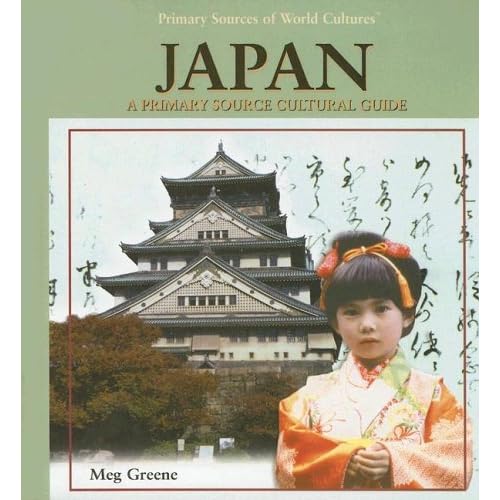
Book Alert: "Japan: A Primary Source Cultural Guide" by Meg Greene


You would think that in this time of endless information due to the invention that is the internet that inaccuracies would not be made. While I cannot say I haven’t made them myself, I would expect someone who is a professional to not makes those errors, especially with books which are used by schools. Out of the umpteen books which my school has which surround the topic of the history/culture of Japan, one of them stood out to me. Most notably because it was the only book to have information on kaiju eiga and Kurosawa. But I am going to focus on kaiju eiga here. While it is fine and dandy for there to be a paragraph on kaiju, it is not ok if there is an inaccuracy on something which has been - up to the book’s publishing year of 2005 - published many times.

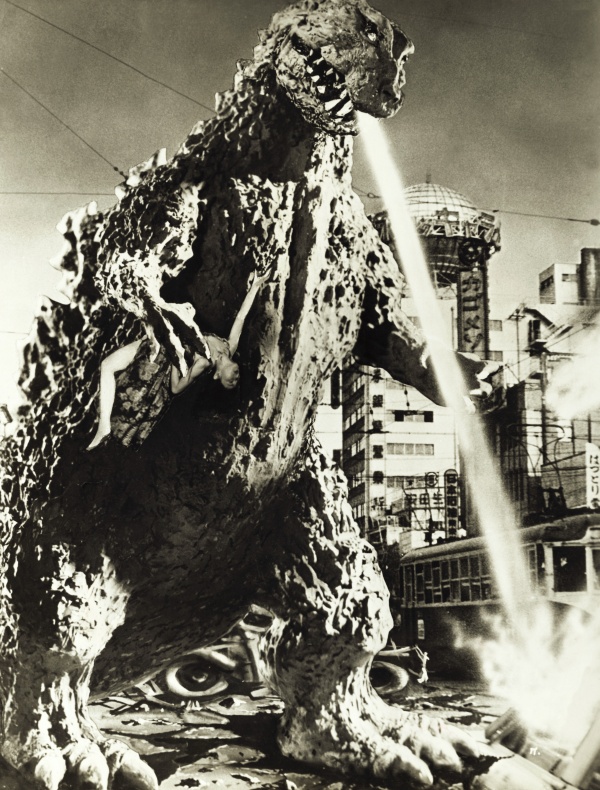
The first offense was the classifying of a still from "Godzilla Raids Again" as a still from the 1954 classic "Gojira". What is even worse, then it comes to the book’s image index in the back of the book, it differs from the image’s subtitle and claims that the picture is from 1955. So if someone who did not know about kaiju eiga was to read this book thoroughly, they would be confused by the different dates which were provided and given the wrong information. The second offense is the calling of "Gorgo" as a Japanese kaiju - instead of the proper classification of a British kaiju film.

Bottom line, you who still go to school and may within the rest of your school years become assigned to do a report on Japan, do not used the book "Japan: A Primary Source Culture Guide" by Meg Greene. With two errors on just one page, I would love to see how many more inaccuracies there would be in the book. This is especially wondrous considering that Meg Greene has written two books on Japan, "Japan: A Primary Source Culture Guide" and "The Technology of Ancient Japan". According to Amazon, she has only published four books.
Fail.

9.21.2009

It's not "Cloverfield 2", it's "Robot-Cloverfield"


Robot Chicken has finally showed it's last new episode for the series, and what a better way to end than with a kaiju-oriented sketch? Apparently, it acts like social commentary on the film "Cloverfield" itself. We see the Statue of Liberty’s head bounce around on New York City’s streets. Not to mention we see awesome scenes with the Cloverfield monster, so good that it looks like they used Hasbro’s $100 toy for it instead of making a cheap clay model for stop motion reasons. This would be the first time that they used a kaiju toy for the actual kaiju appearance, since the kaiju models have mostly been re-casting of Bandai toys (most specifically the Bandai movie monster series Shodai-Goji figure).

As I said, it is social commentary which is brought out with this sketch. People start shouting out rejections like "C’mon man!" and "Dude, it’s only been 8 years since 9/11, not cool." This sounds to be like protest against the film itself, though I bet the animators meant that they humans were talking to the Cloverfield monster directly, because that is what happens. Cloverfield apologizes in a way for the melee he has wrought by building a metal structure out of the 9/11 memorial structure pieces and tops it with an American flag. Everyone seems happy, and right before he leaves, Clover throws a Cloverfield jersey on top of the crowd watching him.


This is a whole hell of a lot better than the faux "Cloverfield 2" trailers. A whole lot better.

Another bit of news - albeit three month old news - is that David Kalat said at G-FEST ’09 that he is editing his book "A Critical History and Filmography of Toho’s Godzilla Series". He is currently fixing errors (like the conflicting information about who originally bought the US rights to Gojira in 1955), adding information, and even doing sections on the Millennium series and may even do another supplemental part which fills in about how kaiju/tokusatsu eiga is doing and how it did between 1995-1999 (even maybe some mention of G2 and G3, like how he did with G1). I seriously think that if he does this correctly, his re-edited version of his book could be the present day "Japan’s Favorite Mon-Star". Though some may claim that Kalat’s observations are far fetched and that he is seeing too much into some of the films - like "Gigan" having commentary on how kaiju stay popular/stay a cash cow. This something which I will anxiously wait for.

Finally some news not related to Bandai Creation figures and Blu-ray DVDs. And as a note, the interview with Michael Keller and Ed Holland of the one and only "MONSTER ATTACK TEAM" fanzine is still going to be done. I currently have Matt’s answers and awaiting Ed’s. I ask readers to be patient. I hope that all who read the interview (when it will be posted) will post a comment saying thank you to these two men. Obviously, they are cutting time out of their lives to do something for the fandom and to do this interview is also a real blessing.

Finally, as a reminder, this Saturday the Atlanta based "Plaza Theater" showing the classic "Rodan". As SciFiJapan reported, it is Ed Godziszewski’s print. Under these circumstances, this screening is a historical event for kaiju/horror/sci-fi fans alike. Hope to see you there. Since the cat is mostly out of the bag, I am going to document the event under the name "OPERATION RODAN". If you would like to be on camera, please contact me via blogspot or forum.

9.04.2009

Classic Media... More Classic Mistakes


Remember the original "Classic Media... Classic Mistakes" article from Henshin Online? Well, the title of this article is a throwback to that.

Though no real surprise, Classic Media really does disapoint with their newest Blu-Ray release. Sure, we were expecting it but they could have pulled off a surprise for the fans. Honestly. I know that Toho charges for all of the diffrent images and videos the companese use for their discs but I do not think that the payment for the usage of the new remastered and RESTORED version of GOJIRA would be that more costly. Major letdown Classic Media. For future refrence, please get the new prints. Though you guys most probrobly don't care about fan responce at this juncture.

8.28.2009

Kaiju Memoir: Silver Scream Spook Show Presents... GMK


This is an edited version of the report.

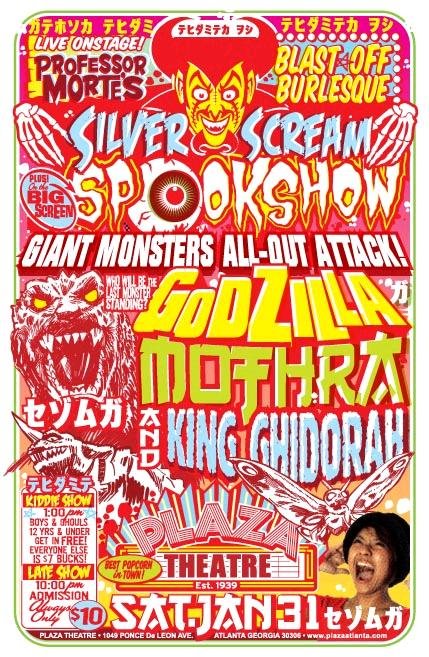
Coppola, Kurosawa, Scorsese - these are all names that are recognized by people who take pride into wanting only the best out of the best films to watch. Another name comes to mind which should be on the list: Kaneko. Shusuke Kaneko is a great director, from making great drama films like Cross Fire (Pyrokenesis) and the Death Note duology to creating films which challenge what were the greatest giant monster films of all "Gamera 3: Incomplete Struggle". Another is "Godzilla, Mothra, King Ghidorah: Giant Monster All Out Attack". GMK, while not as good as G3 (which is good only because of the film's evolution coming from G1 and G2) is considerably better than G1 and G2 and arguably better than the original "Gojira". Back on January 31, the Plaza Theatre of Atlanta, Georgia, which used to be a grindhouse/porn theatre, showed GMK. In this report, we will look into the history of Godzilla in this theatre and what happened at the premiere and if anything else would happen.

First we have to talk about the history of this film. This film has been the most shown Godzilla film ever (in American art houses and cult film theatres). The film has been shown at least eleven times at an estimated six different art film houses and other specialty theatres. And now it’s showing here. According to two articles on Henshin!Online, the way theatres get prints of these types of films is by contacting Sony Pictures Repertory, and with paying $150 and 33% of the box office income, you can show the film that you want (in this case, GMK). At the current time, you have a choice to rent a dubbed version and a subtitled version. It was not always liked that. A subtitled version was made available only a little bit before September 14th, 2004 (and the first article explaining this film was written a year and accouple of days before). The print which was shown was the dubbed version.

So it turns out that this is not the first time a kaiju film has been shown in Atlanta, let alone the legendary Plaza Theatre. Previously, the theatre has shown the films Mothra (February 24th 2007) and Godzilla vs. The Sea Monster (March 29th 2008). As they say, third times the charm, and their third kaiju film was GMK. Two weeks before the premiere, I estimated that only a little more than $35 will be made at the box office. At the end of the 10:00 pm showing, the box office draw became a total of $2,800 (that is both showings together). Attendance to the 1:00pm showing was around 150 and the attendance for the adults-only 10:00pm showing was 250.
INTERVIEW WITH SHANE MORTON (runner of the Silver Scream Spook Show and affiliate of the Plaza Theatre)

Here now is an interview with Professor Mort, the guy in charge of the Plaza Theatre:
1. How well known is the Plaza Theatre and it's main attraction: The Spook Show?
The Plaza is Atlanta's greatest movie theatre as well as Atlanta's oldest continually operating movie theatre which opened in 1939. The Spook Show is Atlanta's greatest theatre going experience! You will see a line around the building twice a day on the last Saturday of every month!
2. What is the theatre regarding to giant monster films (kaiju films) and what Godzilla films have been shown there?
We were the first theatre in North America to show the newly restored Mothra print. We've shown Godzilla vs. The Sea monster, Infra-Man, and the greatest giant monster movie of all time, 1933's King Kong!
3. Sources say that the theatre has shown two kaiju films: Mothra (1961) and Godzilla vs. The Sea Monster (Godzilla, Mothra, Ebirah: Big Duel in the South Sea). Can you recall how successful this screening was. If not, the Mothra screening?
The Mothra screening was a huge deal and extremely successful. In my opinion, it was the most beautiful and colorful print of a film I have ever watched! All of the Kaiju films are well attended and even none of the children seem to care about the subtitles... Hey , were purists!
4. For monster films shown with the "Spook Show", there is a poster made (like the one seen in this link: http://www.scifijapan.com/articles/2009/01/04/giant-asian-monsters-on-the-big-screen-in-january/). Who makes these posters and is there any other information I can get on them?
Kevin Rej is our amazing poster designer and artist. He is a long time Atlanta resident and designs ad campaigns and logos for national companies but still loves drawing Monsters for us! check him out here - http://www.raisestudio.com/
5. What film requests do you get, if you can say some monster-movie oriented?
Everyone has a favorite Monster / Scifi / Horror film and we get requests for all of them. Believe me if it exists on 35mm film and is a classic, you will get a chance to see it at the Silver Scream Spook Show. (or if it is R rated, at Splatter Cinema which The Plaza hosts the second Tuesday of every month.) I have personally fulfilled many of my cinematic viewing dreams at the Plaza Theatre.
6. What monsters films are being planned to be shown in the future?
We have a line on King Kong Vs. Godzilla and many of the newer Godzilla films, but we prefer to show the older ones. GMK is an exception to our rule. Coming up in March we have the 7th Voyage of Sinbad, May we have Creature From the Black Lagoon in 3D, plus more classic Bela Lugosi, Ray Harryhausen, and Vincent Price in the works.
7. What monster films have you seen and liked (if you can, list Japanese Kaiju films)?
Kaiju films, All of them! I am a huge fan and have actually partied with Haruo Nakajima and Kenpachiro Satsuma! (Do not get in a drinking contest with Nakajima, trust me!) I also love any old monster movies. It's too long of a list to put down but I do have an intense and all encompassing love of classic Horror / Monster / Sci-Fi movies!
8. Godzilla, Mothra, King Ghidorah: Giant Monsters All Attack; Mothra; and Godzilla vs. The Sea Monster are all owned by Sony. Do you have any affiliation with Sony and how do you go by getting a print of the films (please be specific with this)?
We have no official affiliation with Sony. The Plaza Theatre has relationships with most if not all the film studios in order to run their films. Getting the films to show is just part of the day to day operations of running a movie theatre. The theatre requests films to the studios, they see if they have 35mm prints, what kind of shape they are in and if they are available. Sony seems to be the only studio that has 35mm prints of Godzilla films that are made available to theaters.
9. What is your goal when releasing a movie like this (e.g.: box office sales and attendance)?
We want to fill the theater of course, but we also want to turn people onto stuff that they are unaware of. Especially in the case of GMK, we are going to blow people’s minds with this movie - and the show! We have never worked so hard on props, magic tricks, etc, as we are on this show. It's going to be stupendous!
10. Anything to say to the people reading this interview?
Yes! Thank you for the support! The Silver Scream Spook Show is a dream come true for all involved and it makes us very happy every time we hear the laughter and the screams of an appreciative audience! Come see the Spook Show, you won't believe your eyes! We'll scare the Yell out of you!

I would like to re-mention from the article that King Kong vs. Godzilla, 7th Voyage of Sinbad, and some Harryhausen films are going to be shown, including Creature from the Black Lagoon in 3D and some classic Bela Lugosi and Vincent Price.

Something about the Plaza Theatre is that it is one of the ultimate fan hot spots in America. As Shane Morton said, if you got a request, he will try to fill it. And also since it is an old theatre, people want to keep it fun. But what do the people think? Here is an interview with Avery Guerra, who is actually a friend of mine. Here is the interview that gives everything from a fan's point of view. I did this interview in way that not everyone has been to this theatre which is located in the south.
AVERY GUERRA INTERVIEW
Q. State your name and history as a kaiju fan concerning writing papers, being staff of official sites like SciFiJapan, MonsterZero, and Henshin!Online, ect.
A. Hi my name is Avery Battles but I'm more commonly known online as Avery Guerra. From as far back as I can remember I have been a fan of daikaiju [giant monster] films. [I should note on your interview questions that I've never worked for any of those sites before. I regularly work for the ones that I mentioned and I am pretty good friends with Kieth Akin of 'Sci-Fi Japan' and stay in regular contact with him. ] You know I was in your shoes just a few years back. I never thought that I would be where I'm at now and with all the connections I've made. I wouldn't ever claim to be anyone special or better than anyone else as I'm just a Regular Joe, but apparently I've got quite a talent at finding news on giant monster [kaiju] films and making the right friends, as I've been told regularly. I think that had a big hand in landing me the jobs as I've become basically a 'news hound' for several sites including; Kenneth Hulsey's 'Robo Japan/Monster Island News' and famous Australian author and film critic Robert Hood's 'UnDead BackBrain' among many others including several mainstream horror movie news sites that I regularly help out. I'm actually not much of an author and only write the articles on occasion. Although I'm told my writing skills are not too bad. Usually, I'm just the one going out there and finding the news and taking it to the right people. I don't receive any pay for what I do, it's more of just a hobby, but I enjoy it immensely. I do however make a lot of connections with movie directors, special effects artists, actors, etc. that will surely benefit me a lot in the future.
Q. How many times have you gone to the Plaza Theatre and what films do you usually see there?
A. I have only been to the Plaza Theater a handful of times to catch some of the Silver Scream Spook Show's monthly screenings of classic horror/sci-fi films. I have been lucky enough to catch 'King Kong [1933], 'The Creature From The Black Lagoon [in 3-D], 'Mothra' [the original Japanese language print] and a few others.
Q. Are you associated with the staff of the Plaza Theatre?
A. I'm actually not in any way associated with the staff at the theater nor with the staff of any of the special events that it hosts such as; 'Silver Scream Spook Show', 'Splatter Cinema' or 'The Rocky Horror Picture Show'. I have been in contact with the host [Professor Morte] of the 'Spook Show' via e-mail through their 'MySpace' page. A very pleasant experience. They are a very professional and friendly crew and put on a fantastic show that's not to be missed.
Q. You mentioned to me before that you recommended a lot of films. Was GMK one of these films and what other kaiju related films did you recommend?
A. I have recommended many films to them for consideration for future shows and "Godzilla: GMK" was actually second on my list of films I most wanted to see as a part of their show. Among the countless others I suggested such recent releases as; "Godzilla: Final Wars" and "Gamera; The Brave", as well as classics such as "Reptilicus", "The Giant Claw", "Gammera; The Invincible", "The X-From Outer Space", "Majin; Monster Of Terror", "Gorgo", "Mighty Peking Man", "Pulgasari" and many others.
Q. How have your experiences at this theatre been to you and have effected you?
A. Each of the shows that I had the pleasure of catching at this theater were exactly that; a pleasure. The staff of the cinema and crew members of the special events were all very professional and courteous and you can easily tell that they have a love for what they're doing. That really helps makes it all a much more enjoyable experience and one that I would highly recommend to others.
Like what Morte said, if you got a request, he will try to fulfill it. May a Gamera film or a Guilala film be not too far off in the horizon?
THE PREMIRE
First, as a Georgian and a South Easterner in general, not a lot of Kaiju related event happen here, excluding Florida. But the one place that we Southerners can always rely on is the Plaza Theatre to show films as a good alternative to other events. Here is how everything went:
I left two hours early. I live in Warner Robins so it is not that long to Atlanta. We got there 45 minutes early, and thank god we did. I was the first to get out of the car (I am only 15, so my mom drove me and my brother to the event) and I got my camera and started snapping photos till I was met my a short woman who was a radio talk show host who was doubling for security. Next, after covering the front of the theatre, I decided to ask a teen aged woman, an employee, if the posters could be bought once the show was over. I was answered with a , "no". I tried getting in, but there was another no. Of course anyone who knows me knows that no one is going to get in my way of kaiju stuff. And then the true magic took it's toll on me.

I had never been to a G-FEST or any type of kaiju-related event. So when I went to the theater and saw GMK and Kill Bill posters and a dealer's table and another table full of free promotional items and a table of display only items (unless you are a member of the Silver Scream Spook Show fan club). In case you were wondering, the items on that table were a bunch of issues of G-FAN, a bunch of Japanese VHS tapes (some from Video Daikaiju), and last but not least a slew of Dark Horse Godzilla comic books.

The dealer's table was actually a guy selling his copies, which he had a lot of copies and stuff. All 6 inch figures were $15, Bandai Creation figures were $5, Bandai Creation 12" figures were $20, and all exclusives were $30. So here is what I got:

-Bandai AFFE Exclusive crystal Gamera 1999 $30
-Bandai Theater Exclusive Gamera 1999 $30
-Bandai History of Godzilla set (from 1999/2000) $20
-Bandai Godzilla vs. Destroyer Diorama $10-Bandai Iris 6" $15
-Bandai Toho Kaiju 6" King Ghidorah $15
-Bandai Godzilla Island 6" Mecha King Ghidorah $15
-Bandai Toho Kaiju 6" Spacegodzilla $15
-Bandai Theater Exclusive 6" Mire-Goji $15
-Bandai Theater Exclusive 6" Gira-Goji $15
-Bandai Toho Kaiju 6" Burning Godzilla $15

Me, the dealer, and a friend of the dealer then chatted. It was nice that I got to chat with other Godzilla fans. We covered topics like our Clubtokyo memberships, Gamera 3 or Gojira, and other Godzilla collectibles. Then some eyes widened when people found out that I got such rarities like the Bandai Large Scale 1991 Godzilla or the Chogokin Kiryu 2002. Then we talked about the CM discs. Total nerd fun. Sadly, the dealer, who I forgot to get his name, had to leave half way through the film to go on a trip to Florida.

After that, I just started taking more and more photos. The theatre, I found out, is like the Godzilla capitol of the South East: the theatre itself keeps Godzilla toys at it's box office stand (a bottle cap with a HG figure of 1974 Mechagodzilla and a Bandai SD Gira-Goji in the corner of a window. The stand, which held the G-Fans and the R2 VHS tapes and the Dark Horse comics, is a monthly thing filled with Goji merchandise; but on occasion other merchandise to other cult films, depends on what they are showing).
Around 45 minutes after I came to the theatre, that is when the crowds came. This is a major learning point for me, a Godzilla fan who is also studying the fandom. G-Fest is the Mecca for American/Canadian fans and those who go are well educated G-FANS who know a lot about Godzilla and other kaiju related facts. This premier was not. So there were more casual fans than die-hards like me. First, the crowd was mostly adult - no doubt either nostalgic people or people wanting to look at a movie that they thought would have a snowball's chance in hell of being shown (a Goji film so to speak). There was no one in my age group there. But there were kids. It was mostly boys, but there was one little Mothra fan who bought a VHS of Rebirth of Mothra (1996). But the main thing was that most people in attendance were casual fans. Some boy's father thought that the film they were showing was Ghidorah, The Three Headed Monster (1964), which I overheard this comment and politely corrected him. Another said that the film was made in the Heisei series, but I corrected that also. As I said, casual fans. The kids were cool though, two younger fans were holding their Imperial Godzillas (did not know there were even collectors in Georgia) and a HG Heisei 1995 Gamera. But I do not blame them, I made my mother hold my Bandai 8" GMK Ghidorah, my brother hold a w/ tag Bandai 8" GMK Baragon and I held my Bandai 8" GMK Goji figure (all figures I bought were but into a box which went into the back of my mom's SUV). Then came the time to enter the theatre, with by the doors two big home-made Godzilla banners. Then the magic happened:
The Silver Scream Spook Show is something which lots of people come to on a regular basis in Atlanta, that I can assure after overhearing the multitude of comments. Audience participation is a given. The Spook Show cast tries to do a 30 minute show based on the movie. First, we had the character Retch give out treats to all the kids who had birthdays, which ranged from the aforementioned HG Gamera and Godzilla shirts to official Silver Screen Spook Show merchandise (stickers and trading cards). Then the show started. First, a semi-burlesque Japanese school girl was dancing around a teacher. Then they went off and Professor Morte (played by Shane Morton) and his henchmen Retch finds an Xilian that tells a prophecy of monsters coming on the 31 of January to do battle in and around the Plaza Theatre. The crew go and give the sea monster (with music from Deep Purple's Smoke on the Water, and the sea monster is not Ebirah) and a giant big foot (they used Toho Kong roars) sleeping pills in which if taken on an empty stomach, makes the monsters enraged. So they have to get Mothra by making her come out of her cocoon to the Shobijin's song with burlesque dancing. Mothra wakes up and is to fetch Godzilla to do battle with big foot and the Sea Monster. Mothra fights Big Foot and Godzilla fights the Sea Monster. After wards the movie began.
Audience reaction to my second favorite Godzilla film was nice. Nothing Rocky Horror like, but it was fun. There was clapping for the Toho logo, the main credits, Godzilla's appearance, Ghidorah's coming to the final battle, Ghidorah getting his wings, and last but not least the end of the film. But there is always expected to be laughter. But sometimes laughter can be a sign of a difference between two different societies. First, I do not understand the laughter at the quote, "It is a bit far fetched" when a guy suggests they name the monsters. Second, the dubbing is ok, I do not see anything wrong with it. Not to forget the laughter when Yuri Tachibana said, "They're dead. The men in the helicopter. They're dead." There was laughter accompanied with a random "You think so?" Honestly, we Americans are so bad at mental stuff. We Americans are always going fast. We text fast, we multi task fast, we like stuff fast. So we think fast and do not ponder/meditate on subjects. This is a bad thing. For instead on thinking, "Why did Yuri Tachibana say that?" and coming to the common conclusion that she is trying to recon with the incredible events which she is witnessing. But we Americans, unless used to the Godzilla films and are a little intelligent, take it that: "She said that? Yo duh their dead! Why say something as obvious as that?" Either A.)This film is comedic and I am an idiot not to realize that, B.)I take these films too seriously, or C.)America needs to wake up. I am glad though that the American people liked the film and that the film's reputation has grown as a good film that even made American critics like it.

On a side note, I bet that the woman who greeted me is a critic who is hopefully going to or already has reviewed the film positively on local Atlanta, Georgia radio. Another thing I wish is that Roger Ebert would be here. While he did not like Gojira much, he did like Gamera: Guardian of the Universe (1995) and therefore hope to get a review of the film from him. When the film was over, my family went and got a photo with Proff. Morte (and I thanked him for the interview) then got a photo with the Godzilla suit (the Godzilla suit was not the GMK suit, it was very well made home made suit with the head looking like the 12" Banpresto figure's head). Everyone seemed to be pumped and I could not go to sleep for another 16 hours after that, since it was my first Godzilla theatrical experience.

In conclusion, it was a well worth event. Sure, I was the only forumer to go but it was a cool experience which a lot of people wished could have been here. And I wished that Packmule and Avery Guerra could have been there. And if you are reading this, you should have been there. It was like a mini G-Fest like none other.

8.19.2009

Cultural References in "Gojira" (1954)


Cultural References in the film Gojira
By Kuroneko-sama

There is no limit to the wonders of diversity. Each culture is different, possessing individual beliefs and practices, each one more intriguing than the next. Nevertheless, many cultural beliefs and practices are virtually similar, such as the various beliefs on the creation of the earth.

Centuries ago, and perhaps even in today’s modern world, polytheism and heavy religious beliefs were central figures in everyday life. Certain rituals were performed in order to placate the various deities of ancient religions, and many basic practices were performed based upon the precepts and guidelines of a civilization’s religious tendencies.

There are also cultural similarities regarding the subject of "courting". Many include the practice of marriage, marital arrangements, et cetera. Courting behavior is also dictated by society, as well as religious influence.

In the film Gojira, there are at least two interesting cultural references that shapes the tale of the lifestyle of 1954 Japan. One is in regards to ancient mythology and religious belief, and the other refers to the practice of arranged marriage. Keeping in mind that while these practices no longer ordinarily occur, they are no less important to the culture of a country than they were so many years ago.

Mythology, Legends, and Folklore
In the original 1954 film, Gojira, mythology is one of the first examples of Japanese culture that we come across, as we are introduced the terrible incidents of death and destruction at sea, and the idea that Odo Island’s deity, Gojira, is to blame for the tragedy. According to one old man, Odo Island would send young women out on rafts once a year in order to placate the terrible god, so that fishing would be good and Gojira would not seek to destroy the island and its inhabitants. During the initial course of events at Odo Island, a ritualistic ceremony of dance is performed, what is described in the 1956 American cut of the original film, entitled Godzilla, King of the Monsters!, as the remains of a ritual that was "all but forgotten".

The tale of Odo Island’s wrathful god is by no means uncommon. Such a sub-plot was utilized in the 1933 film King Kong. Many tales of ancient cultures are littered with instances of gods and deities imposing some form of authority over small villages and even large cities. There is the Aztec legend of the Quetzalcoatl, a feathered serpent god of great power and importance to which the Aztecs would offer animal sacrifices, as it was said the Quetzalcoatl opposed human sacrifices, which was highly common in Aztec culture. There are also tales of European dragons laying waste to different villages, and pillaging the lands, eating livestock and occasionally humans. Tales of dragons in Japan are just as commonplace, although in Asian culture dragons are seen as more benevolent beings, save for those such as Mizuchi, a water dragon known for its malevolent tendencies and for it desire for human sacrifices to be made to it. The most famous Japanese deity tale, perhaps, is that of Yamata no Orochi and Susanoo.

The tale of Gojira also shows similarities to a perhaps little-known tale of folklore, which takes place around 1320 AD:

Hojo Takatoki, the last shikken (regent) of the Kamakura Shogunate, banishes a samurai by the name of Oribe Shima. Shima had insulted or displeased Hojo Takatoki in some manner, and was banished to a prison on the Oki Islands. Oribe Shima had a daughter named Tokoyo, who was noted for her strong character and love of her father. Overcome by grief, she sold everything in her possession in order to search for her father so that she would be reunited with him. Towards the end of her long and difficult journey at the Oki Islands, she comes across a grim priest and a fearful young woman of perhaps fifteen years of age, both dressed in white. Tokoyo stops the priest from pushing the girl off a cliff, and he explains to her that each year a girl of fifteen years or younger must be sacrificed in order placate the deity that held dominance over the islands. Seeing the grief in the priest’s eyes and the angst in the girl’s, Tokoyo asks that she don the white attire of the sacrificially intended, as she felt she had no reason to live without her father. It is agreed, and Tokoyo, who is noted for being an excellent swimmer, dives from the cliff, a sharp knife clenched in her teeth. Whilst down below, she finds a wood carving of the Emperor, and intends to bring it up to the surface, initially believing that the wood carving was the so-called deity. Her supposition is shattered, however, with the arrival with what many have speculated to be a water dragon. She slays the beast, and brings the wood carving to the surface. She is then treated as a hero, and there is a great celebration. With the death of the Oki Island deity, the Emperor finds himself released from a terrible illness, which had been inflicted upon him by the water beast. Upon the discovery of this, the Emperor orders the release of Oribe Shima, and the samurai and his daughter are happily reunited. There is also a hint that the city of Edo (ancient Tokyo) was later re-named in honor of Tokoyo, whose bravery had caused her name to be "known worldwide".

Culture
A little subject matter is occasionally argued upon, but is never truly delved on, is the subject of the "love triangle" in the film Gojira. By today’s standards, it would appear that there are virtually no romantic angles in the film at all. At least one person I have noted has stated that he/she would not have known there was a love triangle at all, had it not been blatantly stated. Keeping in mind the romantic standards of modern society, there is a legitimate reason as to why there is a debate at all.

Japan has always been a country that has kept its traditional values. While today Japan is a very modern society, and, sadly, many of those values have begun to fade, in the 1950s they were still very highly honored. One could compare the relationship between Emiko Yamane and Hideto Ogata as a sort of "courting romance". What we perceive as romance today (i.e. – kissing publicly, et cetera) would have been seen as lewd and, frankly, inappropriate behavior. There were (and still are) subtle indications that a couple is in love. The most common, perhaps, is simply holding hands. With Ogata and Emiko, it is Ogata’s constant attempts at doing little things for Emiko, such as holding her umbrella for her, et cetera. In addition, their behavior suggests only slightly the air of romance. While it is undetected by the modern youth of today, those who look closely and those who perhaps even grown up in strict societies will notice the slight hints of romance.

The type of romance conveyed in Gojira appears very odd to those of today’s society. Many perhaps do not grasp the concept of arranged marriages, which have all but faded away. Arranged marriage is another romantic element of Gojira that has a tendency to confuse modern society, as it is no longer a common practice. For those unfamiliar with arranged marriages, it is the practice of the parents of a young girl meeting with the parent of a young boy, and having it arranged so that the children would one day marry. It was a very common practice at one point, and it was ordinarily between families that had very close relations. With Dr. Serizawa, it was perhaps that he had been great friends with Daisuke Serizawa’s father, as Emiko and he had been betrothed since they were children.

If the concept of arranged marriages sounds startling, imagine what it must have been like to have to have been chaperoned! It was once a highly common practice that a girl and a young man could never be alone together. The girl was always to be in the company of her chaperone, and there were never any exceptions.

-----------------------------------
Thanks!
*~Kuroneko-sama~*

8.08.2009

Review: G2K JP Version

Just when I thought I had seen it all, I was wrong. I finally saw the Japanese version of my favorite Godzilla film, Godzilla 2000. All I can say is wow for the matter. I had seen the first 18 minutes and part of the final fight scene from the Japanese version before and I am happy that I got to try it out, otherwise what I saw would have kept me in shock. So here is my review of the Japanese version.

The film screams rough cut. I am not going to lie, there are many points in the film that the sound for realism is just lacking and is just dull, unlike the US version. Many things which seemed epic in the US version are not in this version. It is rather weird. Though I do like some of the scenes which were cut out from the US version. All of the deleted kaiju action should have been kept in the US version. I also think that the two scenes with the UFO projecting words onto computer screens should have been kept.

There are some things which I am on the edge about. The first thing is the dialogue. I really think that this film needs to be recut a third time, combining into one package the best of both the JP and US versions. And it would have to be dubbed. Really, I do not know what to think of the JP dialogue. There is so much detail in it which actually helps flesh out the human characters. I am right now actually making of own subtitle script for the film. If only I had a DVD copy of the JP version, no doubt I will be making a home made cut on my computer. Really, the human element can be improved on. Both the US and JP dialogue together would make for some great scenes.

The soundtrack is something I am also on the fence about. I can diffidently see where some think that the soundtrack gets repetitive. Owning the soundtrack, I thought it was kick butt. Though now seeing how it was used, especially since the track Godzilla: Dreaded God is in different places through out the film is just awkward. Plus some of the music is just not as epic as the J. P Robinson pieces. Though I would not be surprised. Hattori also did Spacegodzilla. Though I do love this soundtrack. I am also now more appreciative about the added Ifukube tracks in the US version.

Overall, with the cuts and changes Michael Schlesinger did with the film, I do not agree with 45% of the changes he and his crew made. Though I still love the US version and the changes did enough to actualy let G2K be the only Godzilla film without added scenes with Americans to actualy feel like it is it's own entity. The JP version is just as good, maybe a little deeper but not as fun as the US version.