3.30.2017
Reviewing Mothra's Rebirths
The Mothra trilogy seems like a series of productions just to keep money flowing from the occasional kaiju lifeblood Toho uniquely knows how to milk. Like THE RETURN OF GODZILLA, Mothra's return was a brainchild idea of Tomoyuki Tanaka, who probably had good intentions of a quality film respecting the original Motha iterations. In the end however, what we got was a trilogy of films spawned from the much fabled unproduced MOTHRA VS. BAGAN script
.
The first film in the trilogy is not a bad film. Its a decent enough children's film with enough development of the human characters to qualify in the most minimal of ways layered. Episodic gags with the childen and the Elias (the trilogy's version of the Shobijin) keep everything before the monster action lively and well structured. The monster action comes off the heels of the comedy, which really doesn't continue, but we have the monster action which also really reaps a great value of a Mothra film's ability to be a musical, the songs as dramatic scenes unto themselves. Of the trilogy, it combines these three qualities well - a total entertainment film.
Not that there isn't some drama in the film. Its a film with an envionmentally-fiendly message. We have parents who cannot reconcile the percieved needs and their order of priority. Director Yoneda was an assistant director with Kurosawa on his films RAN onward, pobably even learned a lesson or two from Ishiro Honda. He shows he is aware of stoy telling flourishes with the camera like slow-motion photography, but the more dramatic moments fall half flat. For example, particularly, is the scene of the father character riding the bull dozer which releases Death Ghidorah. He communicates enough visually to let audiences see what kind of scene he is intending, but the interplay of images isn't there. The more dramatic scenes only fall half-flat though, some credit is given. A Japanese HOME ALONE or BEETHOVEN would be more up his alley. Anything in the first film that would be considered cringe-worthy really are just uses of older cinematic conventions.
Similar, but not quite the same can be said about REBIRTH OF MOTHRA 2. A new director for the human drama was chosen, and it shows. MOTHRA 2 is more of the Indiana Jones-esque kind of action that drove GODZILLA VS. MOTHA (1992), which really calls to question if this wasn't the kind of atmosphere Tomoyuki Tanaka was trying to procure with the MOTHRA VS. BAGAN project. What the humans may be lacking in any development in the script, the cast makes up fo with their energetic caricatue-esque acting. Missing is the extensive musical numbers, breaking down part of the mythology that the first film in the trilogy set up - Mothra's evolutions and life stages are sung by the Elias as to be a catalyst for Mothra.
MOTHRA 2's detractors come from questionable influences from the concurrently running Gamera trilogy. You can switch out Nelai Kenai with Atlantis, Degarlah with the Gyaos, and Gamera with Mothra. Luckily, as far as the monster himself, Degarlah is a unique creation. His Barrems remind one of the Shokiurus from THE RETURN OF GODZILLA, a sign of his character arc (Descibed further below).
The third film saw the return of the first film's director, with a completely serious tone unlike the first two films, tearing at a certain cohesiveness of the trilogy. Then again, the third film is a boring rehash of the first film's ideas, just mixed in a way that the filmmakers thought were beneficial. Instead of having Ghidorah attain his energy from floura, he gets it from young human fauna. Ghidorah resembles himself and not a four legged cross with Bagan. It seems to be a failed attempt at tying to tie the kaiju stories and the human stories togeather (a possibly good move if done right, layered in with the Shobijin angle). Atleast the kaiju scenes, dramatically, work better as dramatic set pieces than the other two films.
That's the simple look at the human drama of the Mothra films. The human drama is simple enough in these films, with loose thematic connections to the original Mothra films. Crony capitalism is only really looked at in the fist two films, and both of them tie it back in with pro-envionmental themes. By this point in the franchise, a new variety of stock characters have been instituted for these themes: paper company executives and treasure hunters.
The important thing is these films made sure that Toho's SFX crew kept having work, and that Toho kept investing in newer technologies as to keep competitive. Until 2005, the first two MOTHRA films wee Koichi Kawakita's swang song. Afte winning the Japanese Academy Award for GODZILLA VS. KING GHIDORAH and becoming the lagest share holder in Toho, Kawakita definitely had a legacy to protect, to end well. At first, it seems promising.
Kawakita was born to make these Mothra films. His visual style - manipulation of the camera and what's in front of the camea - is on full blast here. Lots of beams, transfoming monsters, use of glitter - it all fits with his fetishes. The sequences are a little more focused than usual, though it can seem at times that Kawakita's scenes consist of loosely visually or narratively connected shots. Again, the inclusion of musical numbers which have to be mixed in with the tokusatsu footage help this out alot. Meanwhile, he is having a blast at making a better Mothra prop with Mothra Leo, the best use of an actual flame thrower is part of the suit, and further use of CG.
The aged CG is forgivable, and the reusing of a four year old Mothra prop with limited mobility is forgivable. What isn't quite forgivable is a lack of some care with MOTHRA 2. The film's ambition of mostly underwater warfare between the kaiju is respectable, but there is a lack of quality. Five years previously, Kawakita filmed an underwater scene between Godzilla and Battra in GODZILLA VS. MOTHRA. Missing from MOTHRA 2 which was in GODZILLA VS. MOTHRA were the composited-in air bubbles, the processing of the sound effects to make the kaiju sound like they are underwater, details like this. Maybe too many CG shots took up the budget. Digital matteing would be another sucker of budget, and though more experimental in execution, the matte shots showcase issues with scale and lighting differences between the main plate and the composite materials of the shots at times.
MOTHRA 3's tokusatsu was filmed by Kenji Suzuki, who relies too much on digital compositing in this film (almost as bad as GODZILLA VS. MEGAGUIRUS three years latter). This ruins good props and suits, particulaly King Ghidoah. Luckily, just like the first film in the trilogy, set pieces are ceated via the intecutting of musical numbers and the monster action.
The best quality of the films is the handling of the kaiju's own personal drama. From the best handling of the death of a Mothra until GODZILLA: TOKYO SOS, to the tagic slaying of a samurai gone mad with Degarla, and the ambitious time traveling aspect of MOTHRA 3, the monster drama may not be as well mixed in and tied with the humans, but they have their own stories that while simple, do offer a little bit of poetry in their own right.
The other great quality to the trilogy is the new songs written for the Shobijin characters. In the first film, the compositions help give the film a light, Studio Ghibli sense of atmosphere at times. In the third film, it helps add a sense of levity to the action between Mothra and Ghidorah. The regular orchestrational pieces of the score are unrememberable, but the songs are memorable and might even lend themselves well when paired with the operatic stylings of a composer like Shiro Sagisu.
In the end, the Mothra trilogy are some nice occasional watches of made-for-the-money movie making. Its very simple fare.
Mothra - 5/10
Mothra 2 - 4/10
Mothra 3 - 4/10
9.14.2016
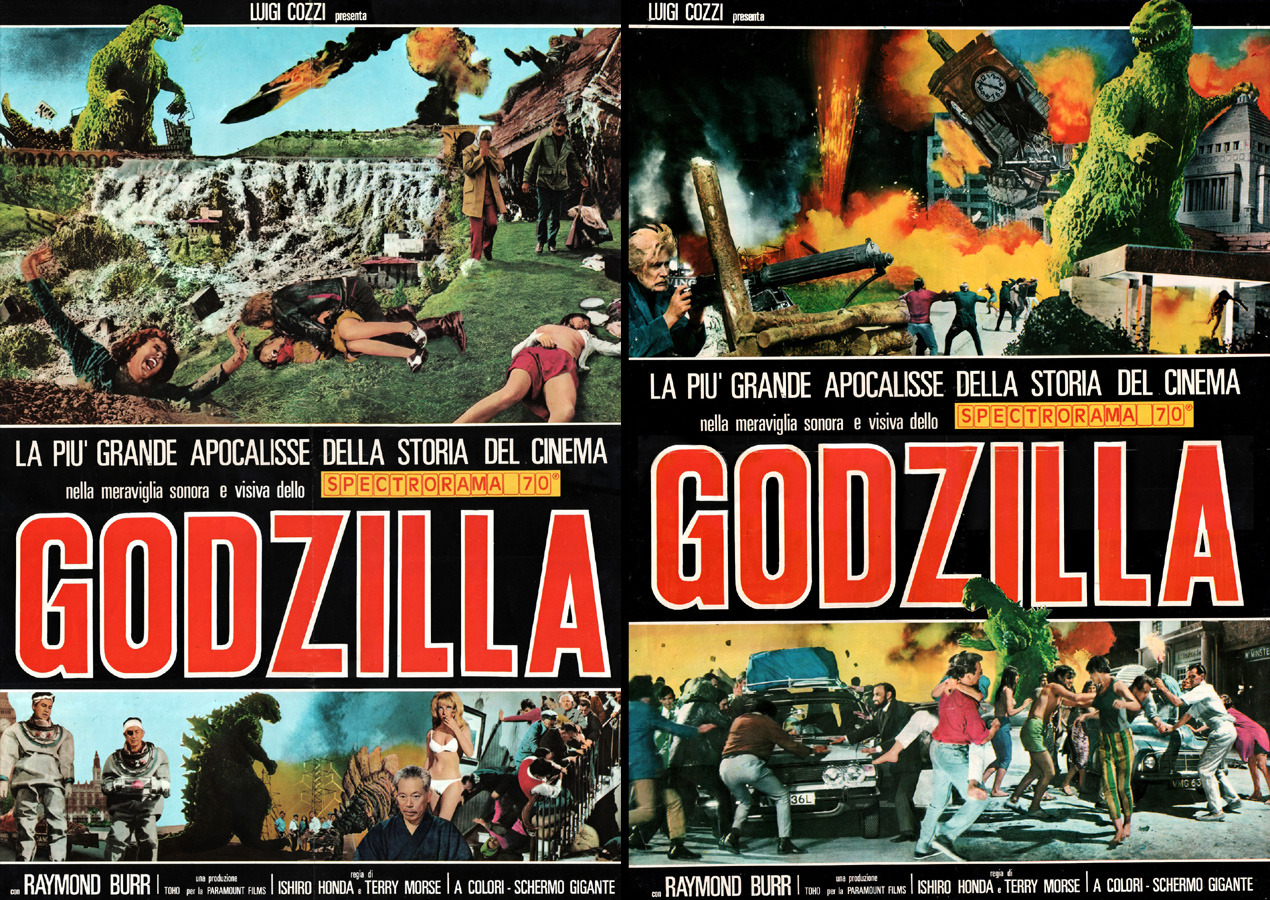
Review: COZZILLA (1977)
This was written on a library computer in less than an hour. Here’s to waiting for SHIN GODZILLA.
The context when reviewing 1977’s COZZILLA is this: one of the many signs of an internationally successful cultural icon is the reiteration of that story by different cultures. There are a couple to note for sure, such as the German dub for GODZILLA, KING OF THE MONSTERS and the American cut itself. To add to that list is an Indian Bollywood film, GOGOLA (which might be grasping at straws) and the lost Phillipino film TOKYO 1960. Italy’s iteration of the mythos does have a couple of things to offer the original narrative, mostly in the realm of the modus operandi and not necessarily the substance. That is not to detract from COZZILLA.
The oddest quality of COZZILLA is that it is a re-editing of a film that lacks cinemtatographic expressionism. Ishiro Honda’s style of filmmaking is closer to impressionism – a style on the rise in post-war Italy. The use of real war-time B-Roll footage (footage as new as shots from the Vietnam War and possibly as old as World War One) doesn’t cut into the film easier because of this quality. Over the whole film is the infamous coloring technique used on the film. Though reported to have been applied frame by frame, noticing patterns in the colors and the duration of these patterns say otherwise.
Director Luigi Cozzi was at a disadvantage when he was creating his professional fan edit of GODZILLA, KING OF THE MONSTERS when Toho only supplied him with the American edit. It might not have been totally advantageous for this grand aesthetic experiment. Many of the nuclear references in the film come from a purely Japanese source, there was a chance that the added footage would have aided this original theme in being sympathized with audiences who didn’t sympathize with the themes of the original film (people who don’t see the bomb more positively than a “necessary evil” and/or sadly put more emphasis on the “necessary” part of that phrase).
The context when reviewing 1977’s COZZILLA is this: one of the many signs of an internationally successful cultural icon is the reiteration of that story by different cultures. There are a couple to note for sure, such as the German dub for GODZILLA, KING OF THE MONSTERS and the American cut itself. To add to that list is an Indian Bollywood film, GOGOLA (which might be grasping at straws) and the lost Phillipino film TOKYO 1960. Italy’s iteration of the mythos does have a couple of things to offer the original narrative, mostly in the realm of the modus operandi and not necessarily the substance. That is not to detract from COZZILLA.
The oddest quality of COZZILLA is that it is a re-editing of a film that lacks cinemtatographic expressionism. Ishiro Honda’s style of filmmaking is closer to impressionism – a style on the rise in post-war Italy. The use of real war-time B-Roll footage (footage as new as shots from the Vietnam War and possibly as old as World War One) doesn’t cut into the film easier because of this quality. Over the whole film is the infamous coloring technique used on the film. Though reported to have been applied frame by frame, noticing patterns in the colors and the duration of these patterns say otherwise.
Director Luigi Cozzi was at a disadvantage when he was creating his professional fan edit of GODZILLA, KING OF THE MONSTERS when Toho only supplied him with the American edit. It might not have been totally advantageous for this grand aesthetic experiment. Many of the nuclear references in the film come from a purely Japanese source, there was a chance that the added footage would have aided this original theme in being sympathized with audiences who didn’t sympathize with the themes of the original film (people who don’t see the bomb more positively than a “necessary evil” and/or sadly put more emphasis on the “necessary” part of that phrase).
The color could have been something which was more interesting. Cozzi must have known the limitations of his Spectorama 70 technique. Not being able to be as intricate with the color gels as others would become a scant five years later with KING KONG, this would release the filmmaker from a responsibility to be realistic with the use of color. More expressionistic, as if the CABINET OF DR. CALAGARI was able to first be filmed in color. The aesthetic could have been taken past the Hollywood gems of old or films like 1946’s STAIRWAY TO HEAVEN.
What expectations are filled and what revelations does COZZILLA make light of aesthetically? The use of color cannot be read into at all. It is a poor attempt to update the film simply for audience quantity sake. It’s unbridled craziness throughout. There is no use really in talking about it any longer.
What is interesting is the added footage. The film is bookended by footage of nuclear bombs going off. The beginning of the film deals with the bombing of Hiroshima. As unfittingly surrealistic the coloring is, the footage does do a good job at creating with documentary footage without any particular aesthetic imposed onto it an expressionistic linear, a dramatic and hyper-real look at the bombing. Subjecting war-time footage to slow motion effects is a great motif. Expressionism which is usually used to help stimulate an audience into believing the current emotion on the screen is happening to them is doubled by the fact that it is documentary footage that we are seeing. There is even a couple of stills that are zoomed out of blended in with the footage. With the colors added, it is hard to tell some of these shots, an effecting tool of blending at this point.
The end of the film is not specific as far as that particular nuclear disaster. In using a cut of the film that omits Dr. Yamane’s theory of more Godzilla awakenings, there is a partial restoration of this theme. The structure is similar how a similar thought ended GODZILLA VS. HEDORAH, with one main difference: Cozzi doesn’t necessarily show that it would be another Godzilla that mankind would be faced with in the advent of further nuclear testing. These events do inform the drama, but do little else to move the story along – it’s just to establish the feeling of the real right before the metaphor is presented. These bookends are the only places within the film that any of the new music composed for this version of the film is used. The cold but rhythmic synth music not only reminds one of Goblin’s music for Gallo horror films from the time (Argento’s TENEBRE comes to mind), but it beneficially separates these sequences from the rest of the film, where the audience should have their attention. The theme’s particular melodies are only played on this second scene.
The version of the film I am reviewing is missing two particular scenes. The first meeting in the diet where we are introduced to Dr. Yamane, and the first half of Yamane’s study of Godzilla’s path on Odo Island being seeing the monster for the first time. This edited down, split into two segments version of the film is what I have, complete with everything except the rest of the end credits.
Of the added footage, all of Godzilla’s attacks are enhanced in some way. The least of these is the Hillside appearance. Lighting, storms, aerial shots is what we have when Shinkichi’s death scene plays. It’s a funny dynamic. These are aerial shots. Being that Godzilla is a large animal, it enhances Honda’s intention of not explicitly showing that it was a living creature causing this destruction in the first place. Really adds suspense if you are into it. Lighting striking across Burr’s face while peering out into the storm from the tent is a good image.
The depth bomb scene’s visual motif of tricking the audience that they were watching a real-time occurrence instead of something on television is enhanced here, though the shots of the boats Cozzi utilizes bear no semblance to the shits Honda had at hand. Cozzi tries to show it as a procedural. These bigger ships shoot off some rounds, then these smaller ships place the depth bombs in the hope of killing Godzilla.
Godzilla’s first couple of appearances in Tokyo Bay and the railroad station is notable. With the use of slow motion, a savoring of terrified faces to out of synch sound is achieved which entices this film goer. Along with that, Cozzi positioned the JSDF to be prepared for an armed resistance of the monster first sight of him in Tokyo Bay. Interesting stuff when it’s not just gratuitous.
Of all these added scenes, Godzilla’s main attack on Tokyo is what really wows. There is the expected re-using of shots which just played less than a minute ago, but Cozzi is a little more careful about this in the main attack scene. The natural and expected lack of sufficient lighting for the monster, along with the colors and the further degradation of the (closest to) original elements, Godzilla is not unlike a surrealist Picaso creation. Sight and sound being out of synch is used effectively, as well as a micro-scene structure of a shot showing a cause being edited into three different shots by effect shots being placed within this cause shot (which is probably slowed down).
It is unclear whether or not, like in every other version of GODZILLA to utilize Honda’s film as a base, the JSDF scares Godzilla away with air missiles or not. If anything, Godzilla comes back onto land. He is aggravated with these missiles. Godzilla’s most threatening like this was GODZILLA, MOTHRA, KING GHIDORAH: GIANT MONSTERS ALL OUT ATTACK. It is during this portion, this questionable Godzilla coming back onto land to finish the job right when he was going to go back to the ocean where the film might be pure metaphor at this juncture. In a strike of operatic grandeur, the Prayer for Peace is played over Godzilla continuing his attack on Tokyo, with intercut footage that – unlike a lot of the other added war-time footage into the film – is too obviously Vietnam. Only footage missing is the infamous shot of the naked girl with napalm burns covering her body. If Godzilla is a physical representation of the bomb, and if the story is supposed to show the horrors of war via man’s interaction with Godzilla, then this is the metaphor used in it’s most abstract in the history of the franchise. Does it work? If it is your cup of tea, yes. The scene beautifully fades from Godzilla attacking admist the Prayer for Peace to the hospital scene. The hospital music/oxygen destroyer music makes for a great non-vocal tail end to the Prayer for Peace.
One of the motifs that show that Luigi did keep in mind a kind of structure when it came to his additions is the lack of any alterations to scene involving the use of the oxygen destroyer, save for it’s actual use against Godzilla (the tragedy of Godzilla’s death is amped up by the over-kill of navy ships shooting at Godzilla while he’s, for lack of a better term, melting). This adding of a relative subtlety to the depiction of the Oxygen Destroyer really makes the weapon come off that much more profound. The oxygen destroyer is a reality still waiting to be unleashed, whereas the bomb via Godzilla has already been let loose into the world.
When watching COZZILLA, it is easy to become bored. The new synth music, the use of color and all of the added war stock footage really makes you think you’re going to see something that is a thrill a minute in the most, maybe artificially aesthetic way. But it is something that if you can get over that you’re watching KING OF THE MONSTERS plain with weird color (As if an old television set had a magnet dragged over it), you may be able to truly appreciate it when these added elements with Honda’s and Tsuburaya’s footage. It’s the most expressionistic Godzilla film, even out doing GODZILLA VS. HEDORAH, and unlike Hedorah, it isn’t trendy pop culture influencing the film.
7.02.2016
GODZILLA RESURGENCE: Backlash? Really?
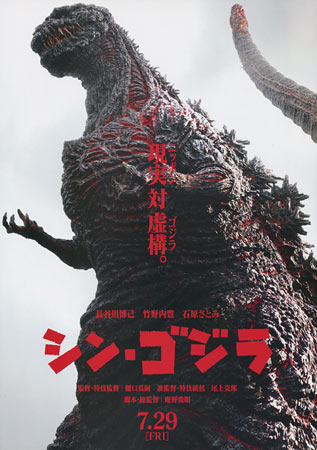
One of the last facebook posts I wrote before loosing internet access was a reply to a post by Japanese filmmaker Shinji Higuchi. One of the rare times that he will actually post about his professional life, he had posted a picture of himself in front of a Godzilla Committee banner with text claiming that he was nervous about this new endeavor. Not that he needs it from me, a person who just befriended him because of his profession, but I wished him luck. A little over a year latter, with my friend's computer at my disposal, I revel news about GODZILLA RESURGENCE, Shinji's Godzilla film (co-directed by Gainax buddy Hideaki Anno). I was surprised to hear that of the leaked photos, two trailers, revealed toys, and other bits of media that personally feed my imagination and has me excited, that there was actually a sizeable portion of the fandom that was totally against the film.
In pure editorial form, I have to ask, what the hell? Is it another case of a Godzilla film, in aesthetic and in substance, being too Japanese for my English speaking compatriots? Is the impression of Godzilla in some older fans minds so solid that additions to the iconography of a certain extreme are seen negatively? Has Legendary's American Godzilla film jaded people? Are fans not used to dueling franchise entries like the James Bond franchise was in the 80's?
https://www.youtube.com/watch?v=PAXYRYxbw08
I do not get the backlash really. I do however need to make sure that the critical work that I see myself doing (and have done since PACIFIC RIM was released in 2013) continues - putting individual films in a proper context as far as genre aesthetics and their evolution and their social significance is concerned. It is through this lens that I hope that maybe I could sway the opinion of some fans against this new Godzilla film (which, regardless of what Toho says, is the 30th Godzilla film - Legendary's film counts).
When Toho first announced that there was going to be another Godzilla film in the works by their hand, it was an odd moment. I wasn't a fan when the first American Godzilla film was released, I am a GODZILLA 2000 baby. I couldn't compare and contrast Toho's decision to make GODZILLA 2000 with their decision to make GODZILLA RESURGENCE, but the logic was (and I remember fandom luminaries like August Ragone saying this, then again human memory is only 60% accurate and this was two years and a lot of life events for me ago) that Toho was striking while the metal was hot. By time GODZILLA FINAL WARS had come out, people had been talking about how the Japanese marketplace was over-saturated with Godzilla. Legendary's film has made Godzilla popular again, and if Toho is going to make the most money they can, then this was the way to go.
Though part of what I have coined to be the Neo-Kaiju genre (a review of 10 CLOVERFIELD LANE is needed on this blog), Legendary's GODZILLA plays into the franchise's longevity. While playing into the tried and true themes of Godzilla, it added to the iconography and substance by providing a proper American take on an anti-nuclear theme. It presented us with a realistic Godzilla that didn't deviate too much from the basic design elements. It was also a well crafted film. It was also a film that came out after Fukushima Daiichi, an important dynamic to remember. It was timely and fleshed out the character in ways that definitely connected to an audience. It also reached audiences who wouldn't see a subtitled man-in-suit Godzilla to save their lives.
GODZILLA RESURGENCE's role is to continue on that work. More of the Godzilla franchise's longevity hinges on GODZILLA RESURGENCE than say the sequel to Legendary's GODZILLA 2 or their end goal, GODZILLA VS. KING KONG. What's the Japanese take on Godzilla after Fukushima Daiichi? Considering the kinds of drama that Hideaki Anno caters to in his narratives, what can he bring to the Godzilla table? How will Japan aesthetically compliment or compete with it's American contemporary? Will tokusatsu SFX come around full circle, surpassing digital images?
If we refer back to the hour and a half long interview Shinji Higuchi participated in on the Heisei Gamera DVDs, we can recall that one of his goals with his films is to produce a distinctly Japanese kaiju film. Because it is one of the only elements that we can talk about at any depth, let's talk about Godzilla's design.

Godzilla's design is very new and very unorthodox. Almost impractical (ironic, considering that tokusatsu is Japanese practical effects). There is a lot in it that harken back to previous designs. The red glowing of Godzilla, most likely a detail of Godzilla's biology that will be newly divulged in this film, reminds a lot of people of Godzilla's design from GODZILLA VS. DESTOROYAH. The shape of the head from a side profile angle looks like the mushroom cloud head design that was originally scrapped when the original Godzilla film was in pre-production in 1954. Godzilla's feet have a much more interesting arc in them - digitgrade legs not unlike Stan Winston's maqette for the unmade 1994 American Godzilla attempt. Small arms, like Noriyoshi Ohrai's advance poster for THE RETURN OF GODZILLA but also posed not unlike the original Godzilla's. Five rows of dorsal fins, like the Mire-Goji design of GODZILLA 2000. Small teeth, small eyes, all of these should be familiar. The dorsal fins even resemble to one extent or another fossilized plants or even tatebanko. A lot subtleties in detail as well. It's a design that is at once extreme, transposing nicely with Legendary's more realistic design for Godzilla, but also really Japanese in aesthetic. And it is a scary design. Unnerving, unnatural, but if executed well enough will be scary - because this living creature on screen doesn't look natural, doesn't look like its existence comes without inherent pain or suffering. And it will kill you, directly or indirectly.
Execution is going to be key. Except for a scene in GODZILLA, MOTHRA, KING GHIDORAH: GIANT MONSTERS ALL OUT ATTACK, Shinji Higuchi has been keeping his SFX work to short films. He's designed special effects for other filmmakers to use (DRAGONHEAD from 2005), but other than that, other directors have taken up directing the special effects shots in his films. When this comes to light, it puts what Shinji has been saying in NHK's series of tokusatsu-focused documentaries in a different light. It all harkens back to the work done on GIANT GOD AWAKENS IN TOKYO and GEHARHA, THE LONG AND DARK HAIRED MONSTER. It all goes back to GAMERA 3: INCOMPLETE STRUGGLE and the SFX used in that film in particular. Digital matting has progressed a lot. Such looks similar in a couple of films - from DRAGONHEAD to ATTACK ON TITAN: END OF THE WORLD. But the more time consuming digital matting of smaller details, more carefully calculated angles for matte shots, and different focuses have been mixed with CG enhanced suits and (because of all the matting) less model buildings than ever before to produce quite an effect. Let's not forget that these suits are not fully body suits anymore. The Colossal Titan was only from the waist up, as might be Godzilla in GODZILLA RESURGENCE. It allows for a better scale for the sculptors to put more detail into, more chances for individuals to puppeteer the suit, and more room for the last line of functionality - animatronics within the suit.
With the originator of these special effects at the helm, on this project, there is to be seen some truly great stuff to look forward to. If the second teaser trailer - which was great - gives those with a different opinion fuel, look no further, a recent cross promotion TV spot with PARCO that a lot of the shots used are not quite done yet - these shots are still being cleaned up and added to. Whether Higuchi and his team make the deadline is uncertain (I am still convinced that originally ATTACK ON TITAN was going to be one singular film, and that the month between the two films is what helped make END OF THE WORLD's special effects better than the first films), but here's to hoping.
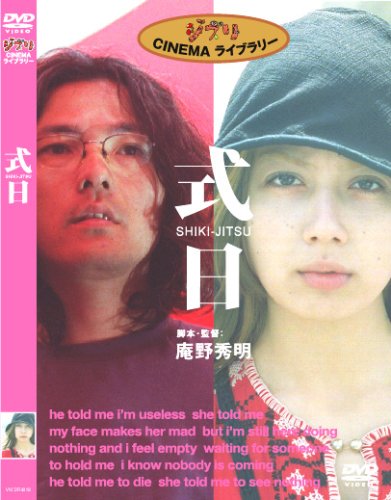
Let's cut away from Shinji for a second. While it's a little disappointing to me that the dream team of the Heisei Gamera trilogy have yet to make a Godzilla film together (left with Shusuke's GMK and Shinji's SHIN GODZILLA), Shinji has someone who is also a fan of the genre and is great with very cerebral/psychological story telling, Hideki Anno. Hideki Anno is a legend. He is the dark side of anime where Hayao Miyazaki was the light side. Hideki Anno has been a colleague of Shinji's for longer than Shusuke, both finding Gainax togeather with a group of individuals who created works like YAMATO NO OROCHI'S COUNTER ATTACK. Hideki is definitely a fan of the genre, seeing his work on Evangelion (which the Rebuild films, though seeming more like another redo of those last few controversial episodes which brought END OF EVANGELION, are still damn good films). He's even gotten close to the closest thing to a scream queen modern kaiju eiga has, Ayako Fujitani, who was the subject of Anno's second film, the biographical SHIKI-JITSU from 2000. Hideki Anno has shown himself to do great work at producing narratives that, without turning the modus operani into metafiction, are deconstructions of the given genre (which is an essential point, from 2005 to 2013 the genre went through it's slasher-like metafiction phase, lets hope it has passed). He is also good at showing the mentality of his characters for the sake of the characters themselves and not the genre that their tale is in. Part of this is because Hideki Anno is a depressed person (there was once a headline in a lot of Japanese media-based publications claiming that Anno's psychiatrist pleaded fans to stop asking Anno to redo Evangelion). The man practically invented the extreme mental breakdown of a main protagonist that has become something to expect, considering its inclusion in works like ATTACK ON TITAN and TOKYO GHOUL.

Based on all of the character photos and the cast we have, and certain some of the more extreme bits of acting/directing in the second teaser trailer (shouting, that last shot of a character running with focus on his furled brow, and the including of the always extreme TETSUO THE BULLET MAN director Shinya Tsukamoto), chances are we are going to be getting depressingly well rounded characters. Godzilla is going to be scary and the characters will be faced with a certain foreboding and sense of dread that should follow a Godzilla attack, a certain foreboding and sense of dread that use to come across to me in films like THE RETURN OF GODZILLA (not anymore though). We don't know if there is room for a sequel, we do not know about the physical limitations of the story - is it simply a militaristic run through of a Godzilla attack?
There are a lot of possibilities here and seeing the source of these ideas, I am almost certain that this is going to be not only one of the best kaiju films since the likes of GAMERA 3: INCOMPLETE STRUGGLE (which had Kazunori Ito of GHOST IN THE SHELL writing for the trilogy it was a part of), but a possible gem stone of the genre as well. I cannot speak as far as an auteur theory reading of the film is concerned in Shinji Higuchi and Hideaki Anno's filmography, but there is a lot here to expect and when the film finally reaches the likes of Kick Ass Torrents (come on, we all know the drill, scouts honor died on the internet), we'll be able to make final assessments. Until then, let's not bash this film (and in return, I won't hype it so much) and instead think about whether or not Toho and their affiliates aren't putting themselves on the fast track to over-saturating the Japanese market with Godzilla yet again right from the get go,considering that EVANGELION and CRAYON SHIN CHAN are doing what HAMTARO did a decade and some change ago.
7.13.2014
Review: VERSUS (Ultimate cut)
I have wanted to do this review for a long time, but every
attempt ended up feeling as if it was not the right time.
Lets put VERSUS in a certain context – Asian cinema had been
thought of, to the masses, be mainly composed of action films. After the Shaw
Brothers’ wuxia boom in the 60’s and all that followed because of it, Asian
cinema became a market for a niche underground market. Bootleg tapes were sold
at conventions, and the films lucky enough to reach American borders were films
that stood out based on the most basic aspects of the production. RIKI-OH, the
films of Takeshi Miike, and BLACK MASK are two examples. Meanwhile in Japan, a
post-modernism was rising in the new Millenium, immediately seen in films like
WILD ZERO in 1999, which the kaiju genre would soon follow. Sam Raimi had left
his mark, independent filmmaking was on the rise, and filmmakers were mixing
elements together. Out of this avarice came Ryuhei Kitamura’s masterful VERSUS.
Kitamura’s visionary directing (brought together by the
editor) is just grand. Not even THE MATRIX, which had come out a year earlier
and set a kind of bar, can touch VERSUS. Every form of combat a human can
subject themselves to is represented here. Swords, knives, guns, bigger guns,
hit and runs by car, all of it is here short of military warfare or giant
monsters (though the epilogue of VERSUS visually reminds reviewers of such).
Such violence is not shot in a gratuitous way like a Tarantino film or a Brian
De Palma way. VERSUS is equally gratuitous, but it is all fantasy and all for
vissal pleasure. While the writing isn’t the most complex, but Kitamura doesn’t
give us eye candy, its eye protein. In the battle which is choosing composition
vs. kineticism in a series of shots that make up a scene, Kitamura can eat his
cake and have it too. In particular to the cut of VERSUS which I prefer –
ULTIMATE VERSUS – (because the film gets a better melding together synth
soundtrack with an ethereal feel), the use of color filters is great. In the
using of colors to symbolize ideas or concepts, you can focus on a particular
color present in the environment you are depicting or you can color the whole
film, and the latter is what Kitamura went after. VERSUS ends up being a very
moody film – but not moods that bog down the viewer. Moods ethereal as the
music that accompanies the film. A continuous sense of awe, of something big
happening, something important.
As far as the writing is concerned, one could go and say
that the film makes a point of fighting being a constant in humanity’s course
through time, but this is a rare case where I would rather not dig deep. To
point out a theme by connecting certain scenes would take away from a
particular function of said scenes. You learn about the characters by their actions.
They all have a personality, and because of tribalism, their means are simple
enough, with drama coming from the motivation of the means. This is expanded
upon with VERSUS being a muti-generational film. Part of the film looks like
its taking place during the sengoku era, part of it taking place in more recent
times, and a part of the film taking place sometime in the future.
Resurrected
versions of characters change motivations overtime, which makes characters
stand out even more. Even deeper are the little (sometimes big) quarks in the
character’s actions or clothing style. Only one character has an identifiable
label (Prisoner KSC2-303). Attentive viewers who do not mind a film being out
of order (or are even people clever enough to absorb a film that is out of
order) will find Versus to be great.
The other great part of the film to talk about is the music.
VERSUS contains a synth score. One of the best attributes to an electric score
is that it can cover a greater range than an orchestra playing instruments. The
score for VERSUS does something that is almost uniquely Japanese and yet rare
all around. Drawing attention to the scene where the character dubbed “The Man”
starts killing those who he has hired on, the music gives that ethereal feeling
of almost a holy action is taking place, complete with an air of hopeless
desperation. The music for the final action sequence in the film and on
perfectly captures a zen kind of patience in battle, when the fight slows down
and so much could be said: thinking ahead for the battle in the couple of
seconds, taking a breather, a sense of awe the characters, ect. The end credits
track brings it all together, that this is an eternal battle.
These three cogs working together is what makes VERSUS the
war machine of a movie that it is. VERSUS, I would hope, will be talked about
for a long, long time. There is too much artistry in this film which has stood
the test of time, truly having excelled the genre. The film has a goofyness to
it, but the film takes it seriously (maybe not the characters, but the people
behind the camera take it seriously). VERSUS is quite possibly the best action
film ever.
6.05.2014
Godzilla Review Part 2: Direction
Let’s talk direction.
Critic’s disdain
for the amount of Godzilla in the film is understandable. Forget the aesthetic
Edwards utilized. From a business/enjoyment factor (the balancing act between
business and art is in itself an art for the summer blockbuster to master),
showing only 15 minutes of Godzilla in a movie which (take away the end
credits) is two minutes shy of two hours is not the best choice. Except for
Japan, Taiwan, and Germany, Godzilla is truly the “event” film which
blockbuster films – specifically claimed by Legendary as their brand – try to
achieve the feeling of. A feeling of a rare happening. Japan had had all 29
(yes, counting the 1998 film which is legally called a “Godzilla” film)
Godzilla films theatrically released, Taiwan had every Godzilla film leading up
to GODZILLA 2000 released in theatres, and Germany got up to GODZILLA VS. KING
GHIDORAH in 1991. For Americans, after the theatrical release of TERROR OF
MECHAGODZILLA in 1978, it was a 7 year wait for GODZILLA 1985, followed by a 13
year wait for the first American Godzilla paired with GODZILLA 2000, and then
another 14 years since the film being reviewed. So business wise, it is not the
smartest. Most countries in the world has not seen Godzilla’s light flicker on
the sliver screen in over a decade and before that, two decades. But Edwards
chose an approach which has also been praised.
First thing to
consider is whether the approach makes sense. Edward’s approach of “wait for
it” along with “lets ravel in build up” is Spielbergian in a sense. This
aesthetic is usually seen in horror films, which Steven Spielberg did have a
hat in with JAWS. Ridley Scott did the same with ALIEN, and arguably James
Cameron with ALIENS. Part of what made it work well with those films was that
through budgetary restriction predating Roger Corman with 1932’s CAT PEOPLE,
such an approach was expected. If a filmmaker decided to show the monster in
its full before the halfway mark – such as John Carpenter’s THE THING – the
filmmakers are ridiculed. Not to mention, JAWS is just a shark, just a shark. A
shark whose life has given it the know how to survive, but just a shark. ALIENS
was less horror, but has a device working for it – the big surprise isn’t the
xenomorphs, rather their queen. The surprise in Cameron’s Terminator isn’t the
Terminator himself, but the exhibition of what the Terminator actually is.
James Cameron’s evolution of such is to hold off just a little, not as much, as
your predecessors, and then when you got this one creature running amok in the
film, present the real antagonist at the end. This is where a sequel to
GODZILLA could work. In the TERMINATOR, the differing look of THE TERMINATOR
offered a device within the film which dread can continue to build.
Again, the
aesthetic borrowed from these films has you wait for the monster, making any
time the monster is on screen enjoyable and not redundant, while also building
in a building suspense that the audience can really revel in. Does it work? To
a large degree, it does. One thing audiences and critics have to understand
that the scenes, such as the tidal wave and the dorsal fins cutting the surface
of the ocean – suspense building scenes though they may be – are indeed
Godzilla scenes. Just because Godzilla is not on camera, doesn’t mean that it
isn’t a Godzilla scene. The presence is there. In the Hawaii scene, which lasts
five minutes, Godzilla is on screen for about a minute, but the sequence is
five minutes long and the audience feels it. In fact, Godzilla’s presence is
transferred to the water. When you see a runway worker crouch down to hide only
to have tidal wave water pool around him, that’s Godzilla’s presence being
alluded to. When we finally see Godzilla roar, his presence accompanied by the
first roar is all we get, and for good reason. That panning up shot of
Godzilla, and the whole sequence, is given the respect to be its own source of
awe. If Gareth had shown the fight, then our attention would be switched from
the opening to a fight scene where audiences would start gaining imput as far
as Godzilla’s presence while fighting, his abilities, ect. Audiences need to
allow their response to Godzilla’s coming ashore and first roar to resonate,
like a fine dish, savor on the palate.
Latter on, the
second time Godzilla rises up (at the Golden Gate Bridge), Edwards plays with
audience expectations. Edwards paints a wide shot of Godzilla’s dorsal fins
coming towards a naval vehicle. While Godzilla fans can probably identify which
section of dorsal fins are being shown in frame, the regular audience member
cannot. Audiences can think that it is Godzilla’s back, but using the element
of surprise (not to make the audience jump, but attain a sense of awe), Gareth
shows it is actually Godzilla’s tail, and the camera pans up as the tail does.
This part of the Golden Gate Bridge scene would not have worked if the fight in
Hawaii was focused on any more than it already had been. This scene uses the
Hawaii scene as a reference point, whether the audience is conscious of it or
not. With only so much Godzilla footage being present thus far – particularly a
good set of shots of Godzilla’s dorsal fins piercing the ocean – the audience
has no other reference point. The audience is made to savor, the audience is
made to be in awe, and then be in awe based on a set up which changes your
perception of what you were initially at awe with, ect.
Another element
of Edward’s direction is the long take. If utilizing the Ridley Scott meathod –
using or seem to be using multiple cameras to film one take, you can get a
bunch of takes where you can choose it leave the scene as one long take or
splice two or three of the takes from different cameras together to form a
small scene. Edwards sometimes opts for the long take. Such as the shot below:
Multiple photographic
techniques are used. Smoke. Silhouette. A juxtaposition of camera movement –
the camera moves smoothly up, but then in rough increments the closer Godzilla
comes towards the camera. Not to mention it is a POV shot ultimately. The shot
is 23 seconds long. Don’t forget the long wide shot of the flooded Hawaiian
streets, which pans right and then up to reveal some of Godzilla. That shot
lasts 31 seconds. The average shot length for a blockbuster is around 10
seconds. These longer shots, which start wide in composition and tighten around
a subject play a dangerous game. A reason why the normal shot length in a
blockbuster film is 10 seconds is because of the average human attention span.
Inspiring a sense of awe is harder and harder than it seems.
Putting these great
images in context though shows how great some of the SFX directors of the
Japanese films cinematographed their shots and scenes. With computer graphics, filmmaking
has become a much more painterly medium, making humanity’s ability to replicate
what he sees come full circle. Within the context of CG’s limitless
possibilities, the thought that say Shinji Higuchi is quoted throughout the
film seems natural. With binding stipulation of having to depict fantastic
happenings after quantifying the quantum mechanics of such on Earth shows
suitamation and analogue effects were not that far off as long as the artists
involved knew how to use the tools given to them, were able to conceptualize
new kinds of shots, and use the tools given to come up with newer tools to make
their new concepts a reality.
CG has given Edward’s (who is tackling both the
monster action and the human drama) an ability to find new spins on old shots.
If looking at a kaiju from a vehicle window, the shot can have the kaiju closer
to the vehicle, meaning tighter composition meaning a better sense of scale).
The clip above of Godzilla roaring for an extended time is an interesting spin –
Gamera was only 80 meters in GAMERA 3: INCOMPLETE STRUGGLE while Godzilla in
this new GODZILLA film is 107 meters among slightly different infrastructure.
Use of lines and the alleyway is similar though.
Yes, I know about the oragami bird's placing being foreshadowing.
Directing the
human drama is a bit different though. Often times, there is nothing completely
mind blowing about the human direction. Brian Cranston’s monologue from the second
theatrical trailer and the tracking shot introducing David Stratharin’s
character are among the more artful. Edward’s knows rhythm though, when to go
from shot to reserve shot to a shot showing what a character is talking about.
What’s important is noticing when the camera looks like it is on a cameraman’s
shoulders, when it is a steadicam, and when the camera is completely still.
There is rhythm and a methodology to such, but Edwards could use some
improvement here. Such as the phone call scene – there is no pattern here. The
lack of pattern isn’t commenting on the chaos of the situation. The camera is
moving like its handheld, but that is about it. The use of chaotic/mismatching
composition as expressionism would be obvious. Rather, the phone call scene
looks like a failed attempt at framing the characters, lining them up with the vertical
center of the frame. Wes Anderson has mastered this, but not Gareth. Its not
bad, but could be better.
Ever notice how the composition of this shot could be very similar similar to a shot of Godzilla dragging his tail?
Monster Action
Gets an A while human drama gets a B-.
6.03.2014
Godzilla Review Part 1: Themes
Lets make clear a
couple of basics which audiences who take film going seriously should already
be aware of. Multi-layered films, films with multiple themes, have a hierarchy of
themes. What that implies is scenes within a film which could mean one thing
take on a duality. Two scenes with a shared expression could mesh together with
another scene for a reason other than why the first two scenes could be meshed together
in the first place. This is the structure of GODZILLA.
In the hierarchy of
GODZILLA, the overall theme is “man versus nature”. It is because of this theme
that Godzilla has become timeless; that Godzilla is a versatile character; why
some critics see this Godzilla film as a nice blending of attributes from the
three past cycles the Godzilla films have gone through (Showa, Heisei,
Millenium).
Secondly is the
anti-nuclear theme. Many viewers who do not pay close attention to the film
will think, as Steve Ryfle has so eloquently described it, “whitewashing”. The
nuclear theme is the fall back theme for the franchise when the need for a
certain realism or darkness is desired for the film. It is a theme which is hard
for this film to express because this is an American Godzilla film. America has
a hard time accepting nuclear anything as bad. Except for filmmakers like
Oliver Stone or Michael Douglas – two filmmakers who have made this a point
over and over again (unlike Stanley Kubrick, in which the nuclear theme in DR.
STRANGELOVE is not the main focus, nor in many of the Cold War or post-Cold War
action films which uses nukes as a plot device) – no one dares to damn nuclear
anything. America has the most nuclear power plants. America, for all tense and purposes, won the Cold War. America used nukes to win World War II. Making a
film like GODZILLA also means America accepting accountability for certain
events. The Fukushima-Daiichi power plant was built with Americans and with
American technology. The Fukuryu Maru, so essential to Godzilla’s inception,
has to be accepted.
With these two
themes working together, there is a spin of time repeating itself in GODZILLA,
which gives scenes which express the aforementioned themes, that much more weight.
This theme will be expressed latter.
Godzilla’s (the
character) ties with the bomb are reconstructed here. Where as many critics say
there is an ambiguity about Godzilla’s tie to the bomb in the 1954 original,
this new American Godzilla – like the 1998 Godzilla – shows scenes of Godzilla
with the bomb. If one stays with the movie alone, Godzilla was awoken when the
first nuclear submarine, the USS Nautilus, maneuvered its way through the South
Pacific. Already man against nature is expressed here – our activities are
effecting a planet that, particularly in the 1950’s, man did not fully
understand. When Russia and America had discovered Godzilla’s existence, a
series of hydrogen bomb “testings” were conducted with the secret intent of
killing the monster. The theme of secrets ties into the theme of time repeating
itself, which will be described when we start talking about the Brody family. What’s
interesting is that the attempts to kill Godzilla, this hidden agenda,
exemplifies the real life reason tests were conducted on the Bikini Atoll in
the first place – an exhibition of how much power each country had at their
disposal. Having the title of “the country that killed Godzilla” would have
attested to the power of the respective country’s arsenal a lot more than a
bomb explosion on a deserted island with only the aftermath to be studied by
the other competing country. Godzilla is also mentioned, like in the Heisei
series, to be an animal which feeds off of nuclear radiation – radiation Godzilla
freely gets from his habitat at the bottom of the ocean, where the Earth’s core
gives off radiation for Godzilla to absorb. If one goes by the prequel comic
book’s spin, GODZILLA: AWAKENING, then the bombings of Hiroshima and Nagasaki
are the reason Godzilla is awakened. Again, man moving in a world that it doesn’t
fully understand. With World War II, man’s capacity for war has gone beyond
hurting eachother, war now effects the very thing such wars are fought over –
land. Nature is unnaturally affected, and for every action, there is a
reaction.
On the other end
of the nuclear spectrum are the Massive Unidentified Terrestrial Organisms, the
MUTOs. The MUTOs come from the same time as Godzilla, a time before dinosaurs
when the Earth was more abundant with radiation. Not an organism with aquatic
adaptations, the MUTOs go after sources of radiation on land – which because of
our post-Cold War world (a world filled with the leavings of the war such as a dormant
nuclear arsenal, nuclear waste from testings, an increase of nuclear energy
reactors), is still available in concentrated doses. Again, human activity
effecting an environment that man doesn’t completely comprehend.
Here the human
characters come into play. With the first MUTO, the male, taking a power plant
as its radiation source, the focal family of this narrative is the Brody
family. This is a generational story, part of what makes this film “epic” (to
use the term Legendary utilized). The first main character to be killed in the
film was Sandra Brody. Russia, Japan, and America are good at keeping things a
secret though, explaining the event was caused by an earthquake. Playing into
the theme of secrets, Joe Brody decides to spend his final years researching
what really happened. Ford, Joe and Sandra’s son, has accepted the official
story and moved on. However, Ford still feels for his father, and is lured into
going to the Q-Zone, the new name for Janjira, the Japanese city the Brody’s
lived in before the nuclear accident. But it is too late, the male MUTO is done
maturing and is ready to come out of its cocoon. Because of this secret, Joe
Brody is killed. His dying words to his son Ford was to protect his family at
all costs. Ford, probably grief stricken over not having listened to his father
in the first place, does everything he can to join in the measures the armed
forces will execute to rid the world of the MUTOs and Godzilla.
While on his way
back in Hawaii, Ford has a run in with the male MUTO while on an amtrack. Right
beforehand, he has put himself in charge of a young boy who had been separated
from his parents – that which Ford had on his mind before the boy got stuck,
him having lost his parents. He saves the boy, and the morning after, tries to
help looking for the parents amidst the debris, only to have the child wonder
away to just find his parents. That is nature in effect. Nature had spared that
child. Time did not repeat it self here.
Yet at the end of
his journey, Ford is on the boat, his mission failed, the female MUTO looking
over him. This is it. Ford lost his mother, ignored his father only to lose
him, and now he is going to die. Ford, having a son himself, knows his son will
be just like his father when he has a child, watching from afar the destruction
of his parent’s workplace. Luckily, Godzilla comes in and saves the day, and
the nuclear bomb goes off without the speculated negative side effects (this
was a point of complaint for many, but reviews have to remember that for a good
couple of hours in film time, the hundreds of MUTO eggs had been feeding off
the energy of the nuclear warhead).
Now, let’s go back
to scenes exemplifying the anti-nuclear theme, along with the man versus nature
theme. The plan to eradicate, by man’s hands, is to use two nukes – one to
attract the monsters off shore, and the other to kill them with the force of
the explosion. Man’s hands are not able to do this; though the weapons are more
powerful than they were 60 years ago, they are making the same mistake. The character
Serizawa points out the folly of such, and the answer he gets is “if you got a
better plan, I’m all ears”. Man goes on with his plans, and they are foiled by
that which he has unleashed from nature. The MUTOs get both bombs – one off of
a train, the other off a boat. Even more vulnerable than the nukes and nuclear
power plants is the locked away fall out, supposed to be protected. But
something happens, and it is let free. The MUTOs are like an earthquake. Can
break down a lot of what man has built. Including what has been built to
protect ourselves from ourselves.
Serizawa says “let
them fight”. Let nature figure itself out. Luckily, Godzilla – nature’s agent – wasn't going against humanity directly. The fact Godzilla is not direct in his
attacks on humanity is cathartic. Critics know that this film uses Fukushima
Daiichi as a point of reference for a real life equivalent explaining the
dangers of nuclear energy. While not effecting the power plant, the real life
Earthquake did cause a tidal wave to wipe away a lot of the Japanese cities
like Soma, which saw a 9.3 meter high wave. If critics didn't already know,
Japan is a nature-centered culture. To have nature strike so hurtfully is almost
like a betrayal. Godzilla being an anti-hero, assumed (think about it hard –
assumed) hero, is cathartic. Nature will pull through.
Nukes are bad. Secrets
will come back to bite you again and again, even if you reveal it, once it’s
too late, that’s it. And nature will strike against humanity if we mistreat it,
there is nothing one can do about it, but it will also pull through for us when
we need it to.
3.23.2014
Birth of a New Sub-Genre – Neo-Kaiju Genre
The Cambridge Free English Dictionary and Thesarus
defines the prefix "neo" as, "new or recent, in a modern
form". Today's modern cinematic landscape, particularly in America, is
filled with post-modernism and metaphysical films such as 1996's SCREAM and 2003/2004's
KILL BILL. Films are referencing and twisting the aesthetics of it's genre,
including films which imitate aesthetics from foreign lands. The kaiju film is
a sub-genre of the monster film.
Distinctly Japanese, the kaiju film's audience from the
genre's heyday here in North America have now grown up and are making films
themselves. Within the last five years, we have seen the come of two films,
CLOVERFIELD (2008) and PACIFIC RIM (2013). These two films, the biggest and
most notable giant monster films from the past five years, were influenced
greatly by the kaiju sub-genre. The history of the kaiju film though is that of
a foreign group of artists trying to put their own spin on a genre from a
foreign land, America which produced movies like KING KONG (1933) and THE BEAST
FROM 20,000 FATHOMS (1953). The kaiju film has come full circle, with the
country who originated the giant monster movie accept kaiju film aesthetics as
their own. Now is the time to explore the genre.
Questions to be asked include what has been brought over
from the kaiju genre, how the Americans have elevated the aesthetic, the
reception of the new aesthetic in the source's home country, and the importance
of the new aesthetic overall. These questions will help build a definition for
a sub-genre of kaiju film, the neo-kaiju film.
DEFINING "KAIJU EIGA"
Long has the whole of cinema's monster films, from human
sized monsters like Dracula and the Wolfman, to that of King Kong and the Kraken,
been generally called monster films, which is interchangeable with the term
"kaiju eiga". Yet has kaiju eiga been used to denote a regional
sub-genre of a genre, similar to how the Italians made the "Spaghetti
Western", a sub-genre of the western. In many books, such as Gina
Misiroglu's THE SUPERHERO BOOK, one would get the impression that kaiju eiga is
tied to the technique of suitamation, which all kaiju films exhibit. An
accurate, though informal, appropriation of what would set "kaiju
eiga" apart can be found in DAIKAIJU: GIANT MONSTER TALES. What is offered
is as follows, "To us, daikaiju tales require monsters of unreasonable
size, impossible and outlandish dimension, relativities that border on (And
sometimes cross into) the utterly absurd... daikaiju are fantastical and
provoke awe through the sheer audacity of their conception." Other
qualities include, "A perchant for city-trashing and
apocalyptic destruction. Metaphorical undercurrents. A
sense that the kaiju are more than just beasts - personality, in other words, albeit
of a non-human kind. Pseudo-scientific and metaphysical pretensions. Vast
scope. Incredible power. A certain cosmic inevitability. Daikaiju are not
scared of Man... classic daikaiju scorn man's military might... They are more
like inhuman gods than unnatural beasts."
To illustrate this point, we can compare and contrast the
1954 kaiju eiga GODZILLA to the 1953 giant monster film THE BEAST
FROM 20,000 FATHOMS. Destruction is a lot more prevalent
in GODZILLA, and when destruction is depicted, it is of a wide
scale. THE BEAST FROM 20,000 FATHOMS has a monster that
can barely tower above the infrastructure the beast is put into by
the story tellers. Another defining aspect is that while
THE BEAST FROM 20,000 FATHOMS helped start off the tradition of nuclear bombs
causing giant monsters to exist tradition, THE BEAST FROM 20,000 FATHOMS
doesn't show that the characters are aware of or feel anything in regards to
that relation, that the destruction caused by the bomb is not yet over with.
GODZILLA, on the other hand, does, as well as a lot of the other kaiju eiga to
have been produced since.
PROLOGUE: AMERICAN KAIJU
Past the numerous pop culture inspired jokes and what not
many tv shows and films made of the genre, there has been only a couple of
times in which original kaiju-eiga styled entertainment has been made. Not of
such is Power Rangers, which is considered by the main stream audience as for
kids, though a growing geek culture is seeing a change in that. 1996 and 1998
saw the release of two independent, straight-to-video productions: ZARKORR: THE
INVADER! and KRAA: THE SEA MONSTER. These films use suitamation and models of a
lower quality to depict their monsters, but the films are largely comedic and seem
to go out of their way to replicate the cheese and schlock of the films that
probably inspired them. Kaiju on television that was original by Americans is
non-existent, though the closest one would get to is the 2012 Hasbro series
KAIJUDO: MASTERS OF THE DUEL. KAIJUDO is an American animated series based on
the card game of the same name (also produced by Hasbro), based on the
Shogakukan-owned franchise DUEL MASTERS. The last venture into kaiju
entertainment would be more independent ventures like Studio Kaiju's KAIJU BIG
BATTLE. Enacted by a troupe lead by Rand and David Boren, the troupe stage
kaiju fights in a ring littered with model cities.
Recorded versions of the fights are available on DVD
through their website. Such is similar with director Takao Nakano's
DEPARTMENT H kaiju fights with people dressing in kaiju
suits to fight to the death (or strip). Merchandise included San Francisco-based
MAX TOY COMPANY's original kaiju figures by Mark Nagata.
But then things got serious.
CASE STUDY #1: CLOVERFIELD
“Japan had this incredible history of having these
incredible monster movies, and we, with the exception of King Kong, never
really tapped into that. We started thinking what if America had its own
monster.” -Bryan Burk, producer
In a 3 part interview of the ADV DVD release of the
Heisei Gamera trilogy, special effects auteur Shinji Higuchi was asked,
"The kaiju films you want to film don't need to have monster
anymore?" The answer was "yes". Through what is commonly termed
"shakycam" cinematography, CLOVERFIELD almost completely accomplishes
this. Shakycam, an aesthetic popularized by THE BLAIR WITCH PROJECT (1999) is a
variant of a broader aesthetic: cinema verite (also known as neo-realism,
according to the Encyclopedia Britannica). It is through the use of neo-realism
which makes CLOVERFIELD aesthetically a parallel to the first known kaiju film,
GODZILLA (1954). Ishiro Honda, applying his experiences as a Chinese POW in
WWII and a witness to the direct aftermath of the Hiroshima/Nagasaki Bombings,
Honda's rarely moving camera creates a documentarian style which is in line
with another kind of post-WWII film, the Italian Neo-Realist film. As J.
Hoberman mentioned in his booklet for Criterion’s release of the original
Godzilla, “Its like a crazy documentary.”
The newer variation of the old aesthetic being applied to
CLOVERFIELD was meant to reach the same depicting of anxiety like the original
Godzilla. As said by Matt Reeves in his audio commentary for Cloverfield,
"From the beginning, a lot of people were saying, 'wow, the movie, does it
have this kind of 9/11, sort of, angle to it?' And in a certain sense, I think
we were always aware that it did in that we felt like it was a way of dealing
with the anxieties of our time in the same way GODZILLA (1954) was, you know.
Genre movies hold that kind of spot in film in that they deal with very real
anxieties that people have, that's why they are effective. Godzilla sort of
came out of the whole A-Bomb nightmare for Japan and the idea of this sort of
unfathomable, terrifying force and that sort of
destructive thing... and all of the anxieties that came
out of that atomic age... those monsters spoke to everyone." Unlike THE
BLAIR WITCH PROJECT, which used shakycam to heighten the feeling of realism,
footage in CLOVERFIELD had a direct real-life parallel: bystander-shot footage
of 9/11. This was America's spin on what made Godzilla dynamic. In DOCUMENT
1.18.08: THE MAKING OF CLOVERFIELD, producer JJ Abrams' motivation for the film
concerned Godzilla. "My son, Henry, and I, went to Tokyo last year. We
went to a bunch of toys stores and I realized, at almost of them, Godzilla was
still featured. It struck me that there was this iconic monster that still so
many years latter still had meaning to the culture... I wish we had a monster
like that."
When talking about the designing of the Cloverfield
monster on the DVD, designer Nevil Page said, “How much has JJ told you about the
whole Godzilla thing?” The Cloverfield monster works as a kaiju simply because
of something else Nevil has said, “Its walking on two legs, and it has the
emotive qualities of a human, but it clearly needs to look interesting and
alien.”
Such influence was also part of the limited use of music
in the film. As Matt Reeves recounts in the audio commentary for
CLOVERFIELD, "One of the fun things about the movie,
because we were actually going to see the aesthetic all the way through... we would
essentially make a movie with no score. And so there is no music in the movie
other than source music... But then, at the end, originally, Kevin Stitt
(editor) when he first showed me the cut of the movie, had taken the music from
GODZILLA, this great score from the original Godzilla and it was just great,
and we sort of thought, 'Oh, wouldn't it be fun for us to do our own version of
that.' JJ and Brian had a great relationship with Michael Giacchino, and it
turned out he was a huge monster movie fan, and that he loved all of that
Godzilla music, and he relished the idea of this... overture at the end."
All of the hallmarks of an Ifukube theme is there n the end credits theme,
"Roar!". Ostanato, the constant repetition of measures within the
music, is present with a lot of bass percussion accompanied by a
Shobijin-from-Mothra-esque choir.
As far as the story's content is concerned, the rather
large focus on the human characters is a distinguishing factor. But make no
mistake, the Cloverfield monster ravashes New York City, not even a nuclear
bomb is able to stop it (at the end of the end credits, you hear a voice say
"Its still alive"). Cloverfield follows through, in its own way, all
of the qualities which would make CLOVERFIELD fit in the dichotomy of
"kaiju eiga".
CASE STUDY #2: PACIFIC RIM
If CLOVERFIELD mirrored the original GODZILLA, then
PACIFIC RIM mirrors the middle 60's kaiju heyday. The further along
the Godzilla franchise went, the lighter Godzilla became.
The audience grew younger, and the films pandered to that young audience (which
only grew since the original film). Along with an audience change, the fusing
of Godzilla with other kaiju properties (particularly 1961's MOTHRA, a fantasy)
an the entering of screenwriter Shinichi Sekizawa gave the kaiju personalities,
common enemies, and made Godzilla a dynamic character. To Eiji Tsuburaya, the
Godzilla series' special effects director, Kaiju were action science-fantasies (more
science fiction though than fantasy). Tsuburaya once said, "My heart and
mind is as they were when I was a child. I loved to play with toys and to read
stories of magic. I still do. My wish is to only make life happier and more
beautiful for those who will go see my films of fantasy." This is the kind
of kaiju film that PACIFIC RIM director Guillermo Del Toro mentions in
"Pacific Rim Featurette: Kaiju", "there is something very pure
and very full of love in monster movies, even more so in kaiju movies."
That is not to say Del Toro doesn't know of the darker origins of the genre.
When being interviewed by the Criterion Collection (which released the original
GODZILLA in 2012), Del Toro said, "Well, the first Godzilla, which I saw
as a kid, was such a gloomy movie for me. It was like a social realism, it had
such drama in it, such sense of tragedy."
Unlike CLOVERFIELD, which shows little of its single
kaiju and has a color palate of desaturated white, brown, black, and some
green, PACIFIC RIM shows a lot of its multiple kaiju in
an environment which utilizes more than a rainbow's worth of color.
Where as CLOVERFIELD was minimalist when showing the
kaiju, PACIFIC RIM has them front and center. Del Toro's view since
childhood was, "When I watched giant monster movie,
the big money shot was the monster, and in Japanese kaiju films, that's what
its about." Mirroring the variety of kaiju the Godzilla and other
franchises had, numerous monsters were necessary. Numerous kaiju resemble,
partially or to a good extent, kaiju from the Godzilla and Gamera franchises.
Knifehead looks like Guiron, Scunner resembles Destoroyah, Otachi is
considerable to a Gyaos, so on, so forth. Design technicalities aside, Del Toro
challenged his kaiju designers. one of the rules I gave kaiju designers was I
wanted to think how a man in a suit would fit in there. The kaijus are trying
to honor the spirit and feeling of the classical kaiju, we are keeping them two
legged... remind you of the spirit of the classical ones."
Remind, not copy exact sequences. As Del Toro has said,
“One of the first things I did is make it a point to not check any old movies or
any other references." To be more specific, “We should not re-watch
Gamera, or re-watch Gojira, or re-watch War of the
Gargantuans.”
Like CLOVERFIELD, PACIFIC RIM has a soundtrack that
adheres to the usual sound design of a kaiju film's score. The main
theme for PACIFIC RIM, though heavy on a rock and roll
feeling, use of percussion for the feeling of an Ifukube piece every now and again.
This would be repeated through out the rest of the soundtrack. In an interview
with Wired, composer Ramin Djawadi said, "For the kaiju, he wanted to stay
more on the traditional side, to pay homage to the Godzilla-type theme, so we
used big trombone sections.So based on those conversations, I sat down and
started writing theme ideas. Before we even put music to picture, I played him
these, and then we started plugging them into the film to see what would
work."
Epic destruction, Giant monsters which are called kaiju
that go so far as to have energy weapons, what next? PACIFIC RIM has
come at a time where every country is picking sides in a
multi-angled build up to an unknowable event. The economy is terrible,
religious extremists are waging war in the middle east,
the last truly communist country is escalating it's nuclear capabilities, and America
is coming down. This is a time where a lot of people believe that they are
living times fulfilling prophecies regarding the apocalypse. In a movement of
international optimism, PACIFIC RIM's story at large is about the whole world.
As Guillermo Del Toro has said, "I didn't want the film to be about a
country saving the world, I wanted it to be the world saving the world".
The weapons responsible for "cancelling the apocalypse" are weapons
which armed forced do not control, with the Jaeger forces going more in tune with
an independent "Ranger" style, which sub-textually offers a reason
why the Jaeger forces win. It isn't the military or the navy, its
rangers.
THE JAPANESE CONNECTION
Other than the obvious influence that kaiju eiga has had
on these two (soon to be three with the up-coming reboot of GODZILLA, from the
same company that produced PACIFIC RIM) films, the films have a common connection
via events in Japan.
In CLOVERFIELD, all we hear about Japan comes from the
main character Robert Hawkins' going away party for a trip to Japan.
While such is ironic considering he is going to be the
victim of a kaiju attack, an almost genre-referential joke, it is also ironic considering
the CLOVERFIELD universe's story which is kept in viral marketing videos (which
are easter eggs on the DVD and Blu-Ray). In the viral marketing, Tagruato - a
Japanese company responsible for the production of the Slusho beverage - has an
Atlantic oil rig attacked by the Cloverfield kaiju. Interesting is that while
english "coverage" of the oil rig attack mentions Tagruato doesn't
know what happened, a Japanese television report quite clearly and frankly says
at the beginning of the report "kaiju".
With PACIFIC RIM, kaiju are actually caled kaiju,
complete with a dictionary-esque definition before the film plays. One of the
main characters, Mako Mori, is an english speaking Japanese jaeger pilot.
PACIFIC RIM's Japanese connection is much more well fleshed out with a couple
of important plot points having taken place in Japan or part of the
universe-specific vocabulary being taken from the Japanese language.
Alas, the films also help by being received in Japan
well. Cloverfield got a prequel manga serial the same year it was released. Published
by Kadokawa Shoten, CLOVERFIELD: KISHIN, takes place in Japan before the events
of the Chuai rig incident.
PACIFIC RIM was well received enough that Japanese
professionals like Katsuya Terada and Yoji Shinkawa making their own
professional posters for the film simply because they
loved the film. Hideo Koijima wrote a multi-tweet message about PACIFIC
RIM, saying, “Dear twitter friends, The followings are my
comment regarding "Pacific Rim". Luckily I was allowed to tweet in
public by WB.I have never imagined that I would be fortunate enough to see a
film like this in my life. The emotional rush I had inside me was the same kind
I had when I felt the outer space via "2001: A Space Odyssey" and and
when I had touched the dinosaur in "Jurassic Park". Animation and
special effects movies and shows that I loved in my childhood days - they all
truly exist in the screen. Director Guillermo del Toro offers this spectacular
vision of massive kaijus and robots in PACIFIC RIM. This film is not simply a
film to be respected, but most importantly, it let us dream the future of
entertainment movies. Pacific Rim is the ultimate otaku film that all of us had
always been waiting for. Who are you, if you are Japanese and won't watch this?
I hope you would accept this inspirational love
letter that had traveled across the Pacific, written by
Director Guillermo del Toro.”
COMMONALITIES: DEFINING "NEO-KAIJU"
This new breed of kaiju film from America can be called
"Neo-Kaiju" through following what CLOVERFIELD and PACIFIC RIM
has in common in terms of style and substance. When it
comes to the kaiju, the main kaiju (singular or plural) has to be close to 250 feet
tall in being able to effectively cause mass amounts of property damage within
a metropolis. American neo-kaiju are usually four armed and two legged with the
ability to be bipedal. The kaiju also have problems with parasites.
The films themselves retain a close tie to Japan, whether
it be a destination or the nationality of a character. The film also ties
itself with Japanese visual aesthetics and musical aesthetic, filming the
monster at a good portion of the time at eye level regardless of logic that would
say otherwise and a score which uses ostanato and brass percussion for a
bellowing dramatic theme or themes.
The content of the film has to show that while it has
themes tied in with the emotional toll of the story, the themes ties back to
the society that the viewer of the film is experiencing. CLOVERFIELD deals with
post-9/11 paranoia, PACIFIC RIM deals with a world whose countries have to
trust each other after a time of political turmoil, and who knows what the future
will hold.
THE RETURN OF GODZILLA
Legendary, being a company that specializes in movies
based on properties with large fan bases with a CEO who is a fan of what his company
produces an the franchises associated, is now finishing their Godzilla reboot,
10 years after GODZILLA: FINAL WARS and 16 years after Tri-Star made their
film. A lot of what the Tri-Star film could have meant for the genre could now
be fulfilled with Legendary's new film. In an interview, the late producer of
the Showa and Heisei Godzilla series Shogo Tomiyama thought that foreign made
Godzilla films were a logical step in the life of the franchise. Shogo said,
"When Godzilla dies at the end of the first movie, a Japanese professor
says there might be more than one Godzilla. This time even though he dies, the
one who comes back for Tri-Star could be a different Godzilla." The 1998
film came and went, thus the new American Godzilla might not be all that
different, with everyone involved with Legendary's Godzilla saying a variation
of the film going back to the themes of the 1954 Godzilla. Interestingly enough,
the proof of concept trailer for Godzilla included a monologue by J. Robert
Oppenheimer, explaining his guilt for becoming the "Father of the atomic bomb". Guilt could be a
theme in the up coming Godzilla film.
As of this writing, Pacific Rim has yet to be released on
DVD and blu-ray, much less on cable television, so Pacific Rim's full impact on
the culture has yet to be felt. Cloverfield's intentions for a kaiju for
America can only be met if they were to make a sequel that captures anxieties
unique to a would so many years after world, depending on how the film's universe
reacted to the New York Attack. Are kaiju here to stay? No one knows, with talk
of summer blockbuster fatigue and kaiju maybe not catching on with the general
movie going audience. But these three films, Cloverfield, Pacific Rim, and
Legendary's Godzilla are part of an interesting new wave of kaiju film. A wave
of kaiju film which the aesthetics, created by a foreign country, have perfected
the genre and have come back to be reinvigorated with special effects and other
modern filmmaking techniques by the filmmakers who were inspired by the old kaiju
films of old. It is a product of two influence cycles. Now we can look foreword
to more independent Kickstarter-started kaiju comic ventures like KAIJU RISING
and WORLD WAR KAIJU (comic books), KAIJU COMBAT (a video game), and a Syfy channel
kaiju television series produced by Bryan Singer (Who helped reinvigorate the
comic book genre with his X-MEN films).
Appendix:
It has come to my attention that talks of a “new era” are about on the
forums and what not. In this rather informal appendix, I would like to point
out a couple of truths.
The first truth is that there is a line of what is and what isn’t a kaiju
film. TROLL HUNTER and THE HOST are not kaiju films. These films are in a class
of their own, particularly with THE HOST, a film more akin to Cronenberg’s THE
FLY than Godzilla. Peter Jackson’s King Kong isn’t even a kaiju film. It doesn’t
borrow any of the aesthetics of such and was made long before the start of the
Neo-Kaiju genre’s birth.
The second point is where future Japanese kaiju productions lie. If one was
to look at more all-encompassing terms like “monster movie” or “kaiju movie”,
then yes, PACIFIC RIM can be grouped along with the newly announced Gamera film
Kadokawa Pictures recently announced. But once the dichotomy has reached its
end, there is a difference between the two films. The Gamera film is, first and
foremost, Japanese. Aesthetics seen in the way of a pre-Pacific Rim world are
going to be shown. Pacific Rim might have caused a surge of intrigue into the
over-arching genre (kaiju), but Pacific Rim – like Cloverfield and the new
Godzilla film – are films which take that Japanese aesthetic and view it
through a different lens.
As for the odd time between GAMERA THE BRAVE and the upcoming Gamera film,
such films are not of the Millenium era. Rather, they are part of a
metafictional series. The films were self-referential of their own genre, and
they cannot be credited as the seemingly rising interest in kaiju – most of
these films faired poorly at the box office.
A good analogy for what is and what isn’t neo-kaiju eiga comes from the
evolution of the western. The western, like the giant monster movie, was
started in America. A foreign country took it and made it their own (Japan
turned giant monsters into kaiju, Italy turned the Western into the Spaghetti
Western), and now we have the genres coming home (the Spaghetti Western has
DJANGO UNCHAINED, kaiju has PACIFIC RIM).
Before we start using classifications fandom-wide, let’s make sure that
such make sense.
BTW, interesting how spot on certain things about this writing have been spot on, considering the original version of this was published a good bit before MUTO toys and such were leaked.
Bibliography
Castro, Adam T. "Why Del Toro Warned Pacific Rim
Designers Never to Watch Godzilla." Blastr. N.p., 17 July 2012. Web. 05
Oct.
2013. .
Clark, Noelene. "Guillermo Del Toro Wants 'Pacific
Rim' Kaiju to 'start from Scratch'." Los Angeles Times: Hero Complex. Los
Angeles Times, 2 Aug. 2012, Web. 05 Oct. 2013.
kaiju-to-start-from-scratch/>.
Criterion Collection. "Guillermo Del Toro on
Godzilla." Youtube. Youtube, 11 July 2013. Web. 05 Oct. 2013.
com/watch?v=I0npWmWUFyo>.
Hood, Robert, and Robin Pen. "Random Observations
from the Editors." Introduction. Daikaiju! Giant Monster Tales. University
of
Wollogong, N.S.W.: Agog!, 2005. Vii. Print.
Interview with Shinji Higuchi (special feature from
Gamera: Revenge of Irys). Pref. Shinji Higuchi. ADV Films, 2003. DVD
Kalat, David. "Gojira vs. Destoroia". A
Critical HIstory and FIlmography of Toho's Godzilla Series. Jefferson, NC:
McFarlane, 1997.
241. Print.
Maloney, Devon. "How the Game of Thrones Composer
Scored the Massively Epic Music of Pacific Rim." Wired.com Conde Nast
Digital, 13 July 2013. Web. 05 Oct. 2013.
.
OtakuVerseZero. "OVZ S2 Ep9 Daikaiju Salon."
Youtube, Youtube, 03 June 2011. Web. 29 Oct. 2013
com/watch?v=nJDLQdlaRL87>.
"Welcome to Max Toy Co.". Welcome to Max Toy
Co. N.p. Web 29 Oct, 2013 www.maxtoyco.com
Subscribe to:
Posts (Atom)