7.09.2012
Looking back over DEATH KAPPA
Oh yeah, here is the plot of the film.
Kanako is an unlucky young lady. Many a time in kaiju eiga have Japanese "idols" cast in a film, but this time around, our main character is... or atleast was an idol. The idol curse is the typicall Hollywood trajedy - people love you for so long and then they go on to the next thing. Idols are subject to the buisness side of the entertainment industry - they are products. Sooner or later, the audience will tire of you and go for the next thing. Either that or they will not buy your products at all, making you a bomb. Kanako didn't go anywhere. The materialistic life didn't work out, so screw it, it is time for her to get back to the old country to take care of her grandmother.
However, when she gets back to the country side, she has a couple of reminders of her life in the big city. Her town is just now getting her merch (which doesn't seem to be selling), and right as she meets her grandmother again, a couple of arrogant teens run over her grandmotheer and leave her for dead - along with bumping into the ocean (with their car) a Kappa shrine. For those who do not already know, the Kappa is a Japanese sprite of shinto belief in which is classified as a goblin with turtle like qualities.
To fulfil her grandmother's dying wish, Kanako has to take care of the Kappa. It is more of an act of devotion rather actually taking care of a sprite... the wish is like saying to someone to take care of the demon in the basement... until it turns out the shrine dumped into the ocean comes alive and eats the cucumbers which were left out for it.
This first act is a nice little metaphor for escaping the modern materialistic culture and escaping back into the more spiritual, olden cuture... of Japan.
Meantime, it turns out that there is a threat within this little town. Problem is, the threat on the surface seems to be good meaning, bringing back the pre-WWII Spirit of Japan. Kanako and the people who ran over her grandmother are kidnapped by decendents of Japaese WWII soldiers who want to bring an elden Japan back... with mutated fish-like creatures which were originaly going to be used in the war. Kanako is saved from these bad guys in a scene which is an amalgram of weird, Saving Private Ryan, and Texas Chainsaw Massacare. It ends with an interesting mix of prctical and CG effects of an atomic explosion. It's the perversion of the drama angle in 1963's ATRAGON.
Such an explosion releases a seemingly unrelated monster (or maybe related, it is not specified, but the main antagonist monster looks similar to the fish soldiers) named Hangyolas who ravages the big city, the JSDF, kills Shinji Higuchi (or rather a character played by him), and battles in iradiated Kappa - DEATH KAPPA - in a battle which mixes sumo, what we can see in a Bruce Lee film when he gets the nunchaku out, and a little kaiju volleyball from a 1966 Goji film.Afterwards, Kappa rips Japan a few new assholes until Kanako wets his plate (he is a kaiju that needs to stay moist).
I guess the message is this: Japan was better off idealistically back some time ago, and the modern materialism or the radical Showa-era spirit are pretty bad things. I guess.
Maybe this whole meta-kaiju movement where kaiju films have to be parodies on the genre is the way of feeling good about something like GODZILLA-FINAL WARS, which wasn't a parody but might as well can be. When it comes to directorial decisions, how do you deal with DEATH KAPPA's style? You try to make a live action anime evidently. That is what the direction seems to be like. An example of anime-esque direction which can be seen here as is the direction is not always logical, rather, acts to add dramatic substance. Sudden costume changes and the flying with the lance shots are evidence of this.
One has to wonder if this is something which was done to attract the audience. It would make sense. DEATH KAPPA is so over the top like it's brother productions like THE MACHINE GIRL and TOKYO GORE POLICE. Maybe even more. Which brings to the next point to clear up (or maybe just wonder about), the American influence of this film. Of the three companies that worked on this film, the one which got top billing is Fever Dream Productions. Another company credited with producing the film is Tokyo Shock. Connecting these dots, it seems as if Americans cannot do kaiju right.
But you got to give it to Tomoo Haraguchi for going the extra mile in bringing us this film, seeing how he directed both the human drama and the kaiju action. He has experience directing both types of scenes, having been involved with the SFX of the Gamera and Godzilla series as well as a director of his own films (KIBAKICHI, which is a yokai film). If execution of certain styles shows the utility of a good director, then I guess Haraguchi did a good job. Just that the script which he was given... sucked. With the TWILIGHT ZONE and THE TEXAS CHAINSAW MASSACRE showing their heads of influence, one has to wonder.
DEATH KAPPA needs a bit, and only a bit, of praise for something though in regards to the SFX side of the production - the creation of Hangyolas. While the suit is meant to look fake, but the kaiju himself looks as if he could kick some major tail. Thankfully, for some individual shots, Haraguchi doesn't go for the documentary approach. It seems almost as if a crane was used for some sweeping shots (even though it could just be the camera moving on track). It is the bit of new wave which is welcomed wholeheartedly.
DEATH KAPPA isn't in need of much more discussion. It was a project to replicate the kaiju eiga of old while making fun of it. The score has to sound epic and Ifukube-like, the SFX has to show strings with all effort to cover them up thrown out of the window, and it doesn't need to be deep. This film, like most kaiju eiga, are products of a money making machine called the film industry, only DEATH KAPPA is more of this than the other products.
Death Kappa is a film which can be enjoyable to watch, but if you are not in a "Death Kappa" mood, forget about it. The bad just raises questions about how the poking fun/meta-physic aesthetic works with kaiju eiga and questions regarding the involvement of American companies involved with the production of kaiju eiga. At least the film can be fun though, with it's message of going back to your roots to save the world and in doing so becoming more spiritualistic (if I saw a Kappa, I'd convert to shinto) and crazy mix of anime direction of the human drama and good ole fashioned kaiju scenes (for the most part).
6/10
4.08.2012
Guy Tucker: The Secret GODZILLA 2 Winner
I contacted a close friend of Guy Tucker’s, August Ragone, and this is what he had to say:
"What Guy said was true — I read a copy of the script right before Guy sent in it to Toho. I wonder if I still have a copy of this script somewhere...
The psychic girl in his screenplay had a direct connection to the antagonist monster — not Godzilla — and her motivation was similar to the girl in GAMERA 3. Revenge. Kind of like Katsura in TMOG, actually. The monster's name was Ankyron. The opening of his screenplay had Godzilla going white-hot from radiation overload — kind of like a meltdown — and attacking Hong Kong."
This is most interesting. Chances of ever reading this script is against us, but it does leave some to the imagination. Imagine if things turned out differently, such as Tucker’s script being the one chosen and that elements from Kobayashi’s script were stolen. Fate is interesting.
4.02.2012
The Deal with GUNHED

GUNHED is pretty bad. Thus, this review of the film will be written in such a manner.
One can think of it as this: director Masato Harada is going through the news and Koichi Kawakita is talking about what is probably his greatest work: Gunhed. Harada would think, "Shut up Kawakita". Except for the production designer Fumio Ogawa, composers Toshiyuki Honda and Takayuki Baba, and special effects director Kawakita, Gunhed is probably a stain on the resumes of those who worked on it. It is an oddity of the type one rarely sees. A blunder which will make people critical of films like GODZILLA VS. MEGAGUIRUS think twice about what is an actually bad Toho film.
It seems GUNHED was to be released internationally in theatres.* We have some characters speaking fluent English, including Brenda Bakke from STAR TREK: THE NEXT GENERATION and a black guy who falls under the stereotype that the black guy gets killed first. Turns out, GUNHED was based on one of the stories turned into Toho’s GODZILLA 2 contest. It seems there were three winners. You have Shinichiro Kobayashi, whose script lead to GODZILLA VS. BIOLLANTE. Then there is Guy Tucker who was unaccredited for the creation of Miki Saegusa and would go on to have elements used in future Godzilla films (a la the intro to GODZILLA VS. DESTROYAH). Finally, there is Jim Bannon. His script was turned into GUNHED. This is what his original script was basically:
What we got was Gunhed, directed by Alan Smithee (I thought that the use of that pseudonym was an American tradition). Alan Smithee is actually Masato Harada… which if you keep with credits, Harada is a Japanese Academy Award nominated director who we Americans most likely know as… the main antagonist from THE LAST SAMURAI with Tom Cruise (?). Guess there has been odder stuff out there.
The story of GUNHED goes something like this: In the year 2005, a whole island was used for the building of a super computer. Being used to make robots, the system KYRON 5 (Vista model) decides that humans are unnecessary a la TERMINATOR. Instead of risking war on a global scale, they fight the computer on its own island. What better to fight off robots than with more robots. Humanity brings in GUNHEDS, which are not too unlike Gundams or as some internet bloggers have likened too, Transforming tanks. Kyron 5 fights them off with biobots, which are robots made from humans put in a green liquid, and the Aerobot, which is a gargantuan leviathan of a robot. These little Gunheds are like David against the Aerobot Goliath. Two big outreaching claws and three "eyes" which shoot out explosive lasers. Even more ballsy, the Aerobot doesn’t even care about breaking through the compound’s walls and pipes (this island’s structure is like the Dante’s inferno of robot cities) just to get to it’s target. It is a truly bad ass robot. Long story short, the Gunheds were effective enough to make ongoing fighting of Kyron 5 unnecessary. These people nipped that Judgment Day in the bud.
Back in the outside world though, computer parts become scarce enough that they are more valuable than gold. Enter our heroes. Flying aboard the Marry Ann (might make you think of COWBOY BEBOP in passing. If anything, it will make you think of Lone Star‘s ride from SPACEBALLS), you have a bunch of bandits who scavenge to sell on the black market. You have the black guy, an Asian chick who can speak English, two Japanese guys who are going to get killed just as easily as the two aforementioned members, Bebe, and our main protagonist, Brooklyn. As in Brooklyn Dodgers. He wears a Dodgers uniform under his clothes (yet his character claims he doesn’t know what it means).
The bandits fly down to the island to grave rob the Gunheds (which, at least the one Brooklyn revives latter on in the film, have a real personality to them, so it is pretty bad). Already, they are off to a bad start. Not only will exploring for severed Gunhed parts going to be difficult, but they see that there is a (Walker) Texas Ranger Helicopter smoldering in the background. Something’s up.
As the Bandits go through the 200+ levels of the compound, they find some interesting things. Such as an advanced Pepsi dispenser. They also find a surviving member of the Texas Rangers helicopter, Nin (the Star Trek chick). Together, they go looking around. The bandits find what they want, but along the way they end up wanting what Nin was sent to the island to get, a vile of Texmexium (yes, ridiculous I know). Turns out, Texmexium has taken over Nuclear capabilities as the ultimate power source (imagine if Godzilla had some of what those super computers were smoking).
It seems as if the Kyron 5 system is still alive enough though. Out of the blue, a biobot knocks Bebe into a vat of green stuff which in turn turns her into a biobot (SUPERMAN 3 anyone?) who is out for one thing: the vile of Texmexium our heroes have. With the Texmexium, Kyron 5 will be back to being fully operational and after a hopeful clean up of the island, will start to rage war on humanity. I could stop now, but there is one other thing which needs to be mentioned in this summary - on the way, Nin and Brooklyn run into two kids - Seven and Eleven. 711. A gas station reference. God.
The direction on the human side of things is nothing spectacular. The writing is full of cheese. The editing (as many internet bloggers have attested to) is of the caliber that should have been bestowed onto Tommy Wiseau’s THE ROOM. Yet the SFX, the production design, and the score help. The film has a definite feel to it. Atmosphere of the type is something not easy to achieve (the opening sequence is really good at this). There is a feeling that you are watching a live action anime (not to make someone think of the craptacular G-SAVIOR). That helps. In fact, it might answer for some of the film’s oddities (such as Seven’s random mannerisms).
The important question is how could things like this get so messed up? Like said, the script was cannibalized into something else. What elements were added to the film? Midnight Eye interviewed director Harada and an interesting bit of information came up: "At one point, I wanted to do a sort of remake of SAHARA with Humphrey Bogart, and that kind of story was incorporated into the Gunhed story." Those who want to make comparisons can read what this page has http://en.wikipedia.org/wiki/Sahara_(1943_film)
On top of that, Harada seemed to have already known that Japanese post-production services sucked (At the time). In fact, Harada did some interesting stuff with this information, using it to involve an American company. "So I need the Lucasfilm people to work on the Gunhed sound effects. They agreed with that, so we went to the Skywalker Ranch, near San Francisco, and I had really nice discussions with the staff there. I had already designed all the different sound effects, like one hundred different tones, 10 different sounds for Gunhed alone." Then Toho comes into the picture. "…Toho, when we talked about the budgeting, just cut the post-production part. So although that was a basic condition between me and the producers, they just totally ignored it. And then I had to compromise with the sound people in Japan. So certain things I was promised didn't show up…"
But of course, the editing is something which we have to come back to. It’s been an American tradition that the director sits with the editor to edit the film together. Isn’t that the way it is in Japan? If not, it damn well should be, because director Harada seems to have a good head on his shoulders, he was just fucked with a good bit. Editing for GUNHED was done by Yoshitami Kuroiwa (probably doesn’t help to note that the first name has the word "shit" in it). GUNHED is plagued with bad editing. That is something which is not debatable. What is debatable though is weather this was the work of a bad editor or if it was an age thing. For my money, it is the latter. Looking up resumes, Kuroiwa - as it turns out - was a major editor. THE RETURN OF GODZILLA and BYE BYE JUPITER are little in comparison to titles like SWOD OF DOOM and KILL (both of which got Criterion releases). GUNHED was made the 55th year of Yoshitami’s being in the industry. He made his bones early on in the late 50’s and all through the 60’s. Either age was getting to him or Toho’s system changed or he didn’t have director Harada sit down with him. Point being, this is not the work of a bad editor.
On the thespian side of things, only one thing can be said: If acting was a priority in this film, then it would only be a priority to two people - Masahiro Takashima and Brenda Bakke/ Masahiro Takashima does a straight foreword job with his role. It is totally believable and isn't as bad as his Japanese or Asian co-starts. Brenda Bakke is an interesting actress though. She plays it all cool, calm, and collective. The fact she does it as much as she does makes it seem as if she is over-doing it. It works in some cases, but not all cases.
The production design is the best aspect of the film. For $10 million, Fumio Ogawa really pulls it off. Except for some shots durring the main battle, the matting is great. Especially when paintings are used (hence why they are great in comparison to the aforementioned battle shots - paintings don’t move). Another simplistic effect are the wire frames. Considering this came out the same year as GODZILLA VS. BIOLANTE (which used wire frames for some of the pre-battle sequences), GUNHED blows the kaiju film away. Of course, they would be CG enhanced with Kawakita’s Japanese Academy Award winning GODZILLA VS. KING GHIDORAH, but this is really a great exhibition of such a technique. There is even use of CG in the film which, considering the Godzilla series’ progression under Kawakita, was a surprise. A floating mine attracted to human voices featured in the film are rendered in CG are good looking. Why the wait till GODZILLA VS. DESTORYAH for some proper use of CG (this is not including things which can be interpreted as computer simulations a la some shots of SPACEGODZILLA and MECHAGODZILLA) via helicopters? Heck, if the CG used here was of the same quality as the alternate version of Mothra’s wing unfolding, I’ say Kawakita should have kept the shot. Not to mention that the Godzilla films had bigger budgets than this film.
In the end, GUNHED is just Toho’s equivalent of a Michael Bay film. Great visuals, crappy execution of the story. At least GUNHED has a cool story which deserves to be revisited (especially in this post-Matrix world). As for why the story is executed so poorly, it is all in the post production. It seems Toho just did not give a damn. Maybe because of changes within the entertainment industry at the time, things were being changed around and GUNHED was a victim of it. Maybe Toho is just poor that way. To note, turns out Kadokawa (who would buy out Daiei a decade plus some later) co-produced the film. Could this be a reason why a GODZILLA VS. GAMERA would not happen (speaking on a business level)? With Toho’s crooked way of doing things, I wouldn’t doubt it. I’m just happy that the score, along with some aspects of the film at least make the film undeniably Japanese (making it seem as if we follow one specific Gunhed the whole film through, and that Gunhed seems to have a kami, along with a very Japanese-felt soundtrack).
*Why I say that GUNHED was aimed for international distribution and that such things as the inclusion of an American actress is not something that was a limitation of the script - Toho could have changed that.
Links:
http://www.toho-a-park.com/event/index.html
http://www.youtube.com/user/Gunhed2039 http://www.midnighteye.com/interviews/masato_harada.shtml
2.29.2012
Review: Mill Creek G3 Blu-Ray
1.30.2012
Review: AKIRA

1.27.2012
Review: SHINOBI: HEART UNDER BLADE (2005)
1.09.2012
State of the Blog 2012
.
Of the misfortunes which have plagued me the last year (and those who know where to look know of what I speak), the most important to talk about would be the fate of my laptop. My HP Pavilion laptop (which I have had since summer 2008) is finally breaking down. Basically, my computer is literally dieing of old age. Long hours of use year around has taken it’s toll and the future of it isn’t clear. What is clear is that to fix whatever problem I seem to be experiencing, it usually calls for long periods of waiting followed by longer periods of restarting the poor laptop over and over again. It seems to be a weekly cycle.
.
If I am on the net, I will hopefully get stuff done. I told a person, who I was forwarded to on good terms, that I would help promote a certain documentary which will excite kaiju fans who can speak English while also rekindling friendships which I feel bad for abandoning. More writing will be done, and hopefully better writing, even if I have to start doing it in longhand and wait to type it up digitally. The DAM DVD review was meant to be edited but due to certain problems it hasn’t been possible. By the time this is posted, it will have been edited. Writing will continue again, though to tell the truth, doing writing on Japanese films is hard without a reliable computer source (just the way things are).
.
If there is anything which anyone wants, feel free to post a comment at the bottom. Remember, I have to approve all comments thus if you do not see it appear immediately, do not panic, it’s all cool. I just want to leave on this note: hope that a piece of SPACE MONSTER GUILALA I have been working on for some time will eventually get completed (anyone who can translated Japanese and would like to team up on this please contact me).
12.05.2011
Review: ONMYOJI (2001)

The story of Onmyoji spans over 150 years worth of history, with the meat taking place in the Heian era of Japan’s history. During this time, humans are depicted as living together with fantastical creatures. Some were Yokai, but the majority were oni, creatures often interpreted as demons. To rid human existence of oni were the Onmyoji, civil servants that worked for the central government. Not only were they tasked with exorcising the oni, but they also predicted future events using tools like the lo pan and the I, Ching (The Book of Changes). They predicted coming occurrences by observing the affairs of men and also observing changes in the cosmos.
In the year 794 AD, the Onmyoji claimed that the guardian of the city of Heian was about to appear, essentially portending ill fortune. One hundred and fifty years earlier, the authorities assassinated Prince Sawara under false accusations. His vengeful spirit could not be calmed until a mound was built, Shogun’s Mound. To make sure the mound was never destroyed, a certain woman, Lady Anoe, was made immortal and appointed guardian of the site.
Back in the "present", unrest builds within the central government. The instability caused by the result of the Mikado's romantic entanglements tips the balance of power, and the head of the Onmyoji, Doson, decides to help Fujiwara no Motokata, the Minister of the Right in the Mikado’s court, who was affected by the shift. His grand design is to create a sense of turmoil to further his brewing scheme of conquest, and resurrecting Prince Sawara is the key to his plan. The one in charge of bringing order out of all this chaos is Minamoto No Tadamasa, a samurai for the court. He teams up with an Onmyoji who, from an hierarchical standpoint, is under Doson. Nevertheless, this Onmyoji proves to be more skilled and powerful. His name is Abe No Seimei...
The direction of the film by Yujiro Takita pursues no other course than that of drama. Each scene is brought to life in a way that utilizes a dramatic cue in the right place at the right time. There is tension developed between the two protagonists Seimei and Hiromasa, and there is tension between the court officials; that is what a story of this nature thrives on, and Takita makes sure that we see the emotions that are racing through this intricately woven tale. There are also visual shots that are incorporated in such a way as to portray the traditionally perceived beauty of the of Heian era of Japan. This is not to say that Takita is one of the best directors around. Admittedly, none of these shots hold any metaphoric value. The tale is told with simplicity through and through. However, the cinematography is keen, with sets detailed to an exquisite degree.
The most interesting part of the film is how it interprets women (the underplayed sex of Japan’s culture from that era) as the movers and shakers of events. The film makes the point that women should not be purely used for political and/or personal gain. Lady Anoe was, and still is, in love with Prince Sawara. It is the presence of the Mikado’s new baby that causes turmoil within the court. His old mistress, Sukehime, is pressured for not being "good enough" or "beautiful" enough to keep the Mikado’s fancy, and yet she is still used... transformed into a Namanari in an attempt to kill the Mikado. There is no fury quite like a woman’s scorn, but it is even more dangerous when one is able to manipulate that age old chestnut for personal gain.
Nomura plays Seimei excellently. It is mentioned that Seimei was rumored to have been born from a fox, and Mansai’s facial features definitely show off this side of Seimei’s personality. Seimei is a unique character, often a little alienating to the people around him, particularly towards Hiromasa. However, this is a character who does show laughter, worry, a sense of urgency, and deep contemplation. Mansai covers all the emotional bases very well. The viewer may be taken out of the film by his performance only when Mansai is directed to cry. It is a hit or miss for viewers, but for this reviewer at least, it was a miss. Other than that, he excels, especially when he has to do rituals that involve certain dances.
Sanada plays a classic villain. A manipulative villain who has a quiet class and reserve about him. Only during the last third of the film does he really show an "end of the ropes - anything goes" attitude. This is something to be expected from the actor, whose villainous characters have become more and more numerous since this movie (e.g. Rush Hour 3). There really aren't any idiosyncrasies in his performance that are strong enough to pull the viewer out of the experience.
The rest of the actors and actresses do their duty to one degree or another. Hideaki Ito, who plays Hiromasa, pulls off the comic relief, hamming it up with aplomb. Kyoko Koizumi is the shining star of the female troupe, playing Lady Anoe, a woman who is immortal and carries around the usual baggage. She helps to bring a solid layer of drama to the film. Yui Natsukawa, the Lady of the Full Moon, is the woman who suffers most of the torture that arises from the Seimei-Doson conflict. She doubles not only as a melancholy-laden mistress but also as the oni/vampire-esque Namanari. Playing Mitsumushi is Eriko Imai, whose character is somewhat superfluous, except to add dramatic force to a few scenes (which require her to go into her butterfly form).
The score for the film is masterfully composed by Shigeru Umebayashi. Although the orchestra isn’t as full as it would be in the sequel, it still proves to be more than functional and helps to cradle (and even magnify) the feeling and emotion in several scenes. The best thing about the music is that it has a distinctly Japanese flavor. Not only does the style reflect this aurally pleasing aspect of the film, but also the choices of instruments lend to the atmosphere. The best example is the theme that plays over the end credits. The use of Japanese woodwind, string, and percussive fair really accents everything nicely, not to mention the occasional (and welcome) vocals.
For kaiju fans put off by the mystical elements of films such as Gamera 3: Incomplete Struggle (1999), Onmyoji is a nice place to start when gathering some cultural insight. While not a full history class on Japan, it does provide a solid starting ground on understanding Japanese mysticism and how it may have affected peoples' lives long ago in classical Japan. Careful directing, competent writing, shining performances, and a sound musical score (with a slightly addicting nature) make this film a winner. It may not be Kurosawa, but Onmyoji certainly stands tall on its own two legs.
11.24.2011
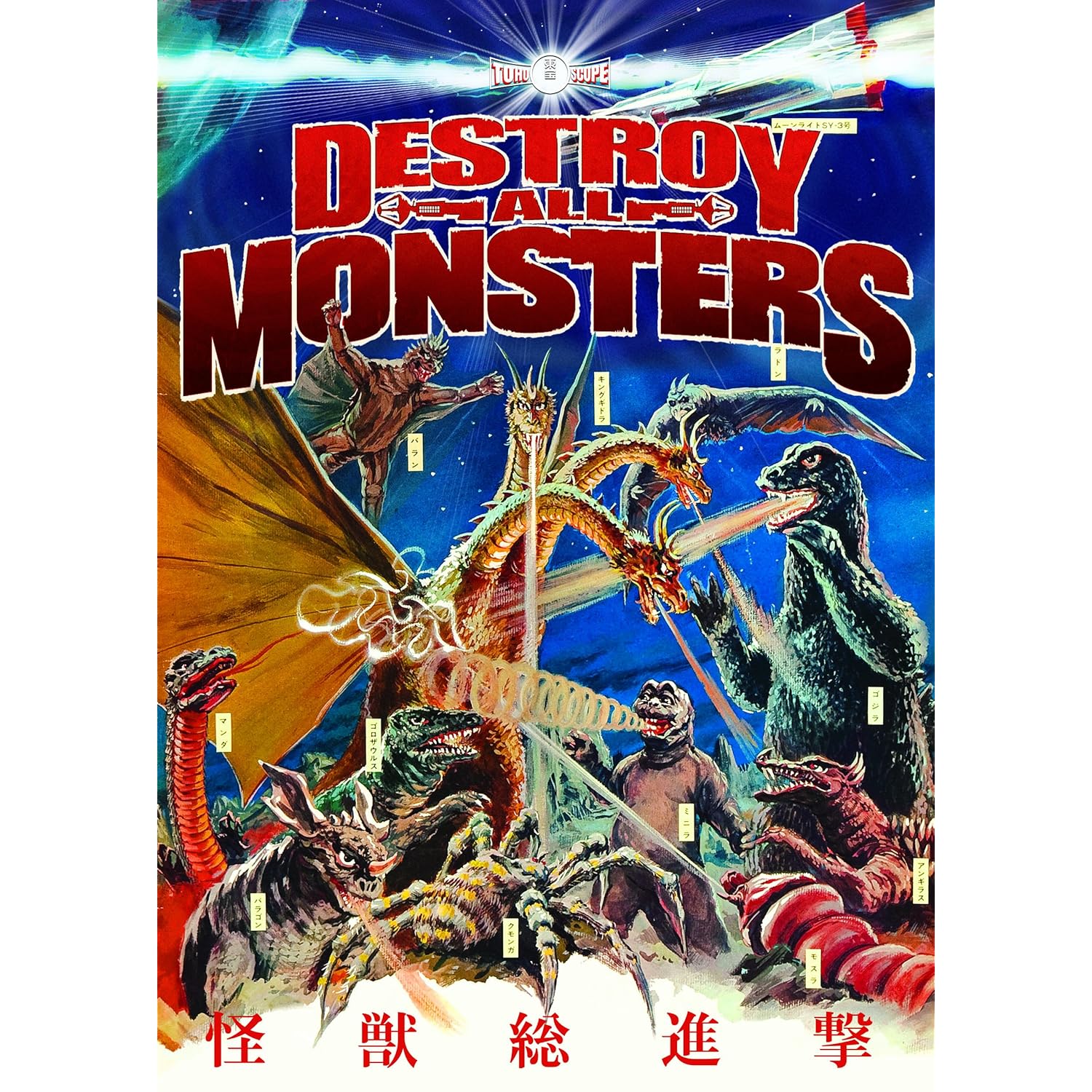
DVD Review: Media Blaster's DESTROY ALL MONSTERS
.
Video: "As you would expect, Toho's domestic DVD release of "Destroy All Monsters" is once again a pinnacle in the line of kaiju releases. The video quite frankly looks like it could have been shot yesterday. As far as I could tell there was absolutely no print damage, bar some very tiny specks of dust in once scene, and no signs of digital artifacts. On occasion there is some light grain, but really only noticeable under close inspection. The film remains consistently sharp with lush and vivid colors. The film is presented in it's original widescreen ratio, and is enhanced for widescreen TV's."


Audio:
There are three audio tracks to the film, which the choices for the tracks are those which would be most relevant to American viewers. One Japanese track (2.0 and 4.1) and two English tracks (international and AIP).
Both Japanese and International tracks are on here and are flawless. They sound like any other audio tracks. Sure, it doesn’t stand out (though it may if you are watching this with a great set of earphones, which pretty much keep the sound waves up close to your ear drums therefore the dissipation of the sound waves isn’t a factor), but there isn’t problems really.
The main attraction is the audio commentary by Steve Ryfle and Godziszewski. Plugging their book here and there, they do stay on topic of the film and having been doing research for their book, it helps a lot. A lot of details and trivia revolving around the film were made freshly known to me, such as the actor of a stage play being treated to seeing the kaiju and an actress from the film. The only downside would be that there are a couple of parts of the commentary where Ed and Steve’s voice could sound a bit more dynamic, making the commentary sound more enjoyable to the ears. Other than that, they do the same good word they did with the films they commented on for Classic Media.

Conclusion:
If this is a sample of things to come, I cannot say that I am not happy for what Megalon will bring. Great audio and visual content with a great bit of special features - particularly the concept art and story board galleries and the trailers/tv spots which are most interesting if only to get a glimpse at what the generation before us could have felt when they would watch these films at the cinemas nationwide in lieu of chance exhibitions at art house theatres. A great release which everyone should own. For an American release of a foreign film which is not being released by a big company, this is a spectacular release.
11.12.2011
Citizen Hyung Rae and the Death of Younggu-Art
For some of us, we like bad movies. Bad movies can be entertaining. Thus, even though it would be a small one, there was an audience for films like 2001 YONGGARY and D-WAR: DRAGON WARS. For those who are American, you might even have a taste for THE LAST GODFATHER, the only English-language entry of Shim Hyung Rae’s Younggu series.
Sadly, we might have seen the death of his brand of Korean cinema, meaning the possibility of no D-WAR 2, which some wanted to see. If you check, the official website has been shut down (the main Younggu-Art side along with the official D-WAR and 2001 YONGGARY sites).
Late October, it was reported that 43 employees of Shim Hung Rae’s company - Younggu-Art - were suing him for $790,000 in non-paid wages. It was to be paid with money received from the auctioning of the 1,655 square meter building which housed the company. The building was sold by Hyundai Swiss Mutual Savings Bank, (Younggu-Arts’ collateral security holder) and was bought by a developer - the only bidder. 3 month’s wages and 3 years severance pays would be paid through the profit made from the auction, with the rest going towards Shim‘s debts. Turns out Shim had borrowed 1.1 billion won against his company, something confirmed by the Financial Supervisory Service. This could be one of many tales of company funds being used inappropriately. Stories of gambling addiction revealed by former employees aren’t making things better.
Turns out that this is not the actual death of Younggu-Art. That happened back in 2009.
Back on July 19, 2009, Shim said he was shutting the firm down - claiming to be $36 million dollars (41 billion Korean Kwon by today‘s exchange rate) in debt. That isn’t the worse of his troubles. In May of 2009, Hyundai Savings Bank filed complaints in regards to 4 billion won in loans/interest. Four months later, a high court made it that Shim had to pay 2.5 billion won. The case is pending at the supreme court. In separate auctions, Shim’s two homes (one being a Hyundai apartment in Apgujeong-dong and another being a Tower Palace apartment in Dogok-dong) are being sold. One of them is 244 square meters in land area.
Shim’s fate just might be sealed when it came up that Shim was being investigated for illegal firearm remodeling. Even darker, claims have been made of Shim’s trying to influence political and business colleges via prostitution including what the Korean Herald said, "high-profile figures and young women" and even going as far as to deny investors refunds of investments back in Oct. 2009 with an illegally customized gas spray gun.
As of October 30, Shim Hyung Rae has been banned from leaving the country of South Korea. All allegations against Shim are said to have taken place from 2008-2011, the years in which Shim made THE LAST GODFATHER (Which failed at the box office in Korea and America) and was still producing MEMORY OF BREAD. Be watching, for SciFiJapan’s Korean correspondent Kim Song-Ho is to be writing a more in-depth article on this.
This is a sad day.
Sources:
http://www.koreaherald.com/national/Detail.jsp?newsMLId=20111023000245
http://news.asiaone.com/News/Latest%2BNews/Showbiz/Story/A1Story20111031-307891.html
http://english.chosun.com/site/data/html_dir/2011/11/01/2011110101160.html