7.20.2010

Kaiju Book News for the Masses!

NOTE: ROUGH TRANSLATIONS AHEAD!

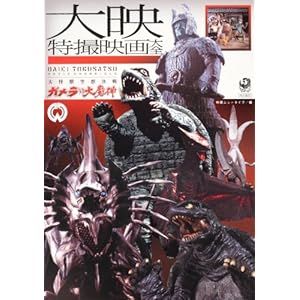
Gamera and Godzilla has come back for the attack this latter half of the year when it comes to books! First up is the book "Daiei Tokusatsu Film Encyclopedia: Daikaiju Fantasy Battle - Gamera vs. Daimajin". The book is 121 pages long, and with a price tag of 1890 Yen, with these stats:


ISBN-10: 4048545116
ISBN-13: 978-4048545112
Release Date: 2010/7/16
Product Dimensions: 11.6 x 8.3 x 0.5 inches


The second with a nice pic of a Bandai vinyl is roughly translated to "Goodbye Godzilla who - far from war". At a much longer 280 pages, the book is a fair 1995 Yen in cost. Here are it’s stats:
.
ISBN-10: 4000230352
ISBN-13: 978-4000230353
Release Date: 2010/7/29
.

The third is THE MUSIC OF GODZILLA: THE ECHOES & THE ERA OF AKIRA IFUKUBE, MASARU SATO, KUNIO MIYAUCHI AND RIICHIRO MANABE" ("Gojira-no Ongaku - Ifukube Akira, Satou Masaru, Miyauchi Kunio, Manabe Riichirou-no Hibiki-to Sono Jidai")(thanks to James Ballard). Acording to August Ragone, "The author is Atsushi Kobayashi, who had written two previous books on Akira Ifukube (as well as other film composers, such as Masaru Sato), and the publisher is Sakuinsha. This particular book will only cover the Godzilla scores from 1954-1975." Gonna be released on 8/10/2010 containing a whooping 480 pages. Here is the book’s stats:
.
ISBN-10: 4861822998
ISBN-13: 978-4861822995
.
.
Happy Buying!

7.10.2010

New Book: "Kaiju Life - The Original Godzilla Actor Haruo Nakajima" by Haruo Nakajima

Title via Japanese: "怪獣人生 ~元祖ゴジラ俳優・中島春雄"
Publisher: "洋泉社"
Language: Japanese
ISBN-10: 4862485898
ISBN-13: 978-4862485892
Release Date: 2010/7/16
.
There will be pictures. For more information, someone more versed in Japanese can go to links below:
.
.
Could this be part of the "The Ghost of Godzilla: The Man Who Was Godzilla: On The Shoulders of Monsters: In the Shadow of the Monster: Unzipping the Mystery" documentry that Haruo Nakajima is supposedly working on with "Team WereWolf" (so says wikipedia)? More details tom come.

7.04.2010

First TV Spot for "MM9"

Thanks to the Nippon Cinema site, we can now see the official monster-less TV spot for Shinji Higuchi's "MM9":

http://www.nipponcinema.com/blog/tv-spot-for-shinji-higuchis-mm9/

And it is interesting to note that the trailer shows a new website adress for coverage of the series:

www.mmmmmmmmm.jp

Very cool indeed.

7.01.2010

Plaza Atlanta Theatre's Silver Scream Spook Show GODZILLA VS. GIGAN details


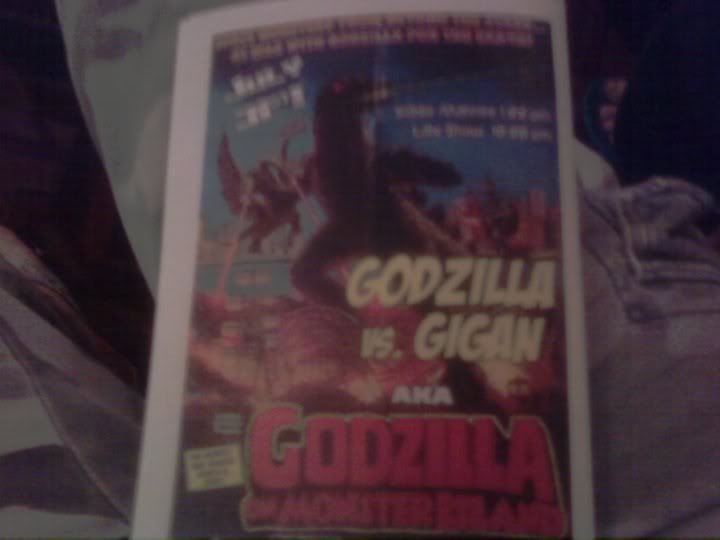
This July 31, the Plaza Atlanta Theatre in association with the Silver Scream Spook Show will be giving a special presentation of GODZILLA VS. GIGAN, under the name GODZILLA ON MONSTER ISLAND.
.
The theatre is Atlanta’s oldest cinematic venue. A uniscreened theatre, it was once a grindhouse theatre which is now run for non profit and has film showing everything from THE ROOM to THE ROCKY HORROR PICTURE SHOW to even film festivals hosted by Robert Osborne (who does things for the TCM Channel - including one time giving an into on TCM to "Space Monster Guilala"). The Plaza Atlanta theatre has a good history with kaiju fans, including having previously screened "Rodan" (1956), "Mothra" (1961), "Ebirah, Horror from the Deep" (1966), "Destroy All Monsters" (1968), and "Godzilla, Mothra, King Ghidorah: Giant Monsters All Out Attack" (2001).
.
The Silver Scream Spook show is like Mr. Lobo or "Ms. Monster’s Hell On Ice" meets Vaudeville. Shane Morton and his group put on the "Silver Scream Spook How", a 30 minute show put on before each of their screenings with some Horror Host elements which helps integrate the show into the film to be shown (to some extent). The sketch they put on has something in relation to the film they will be hosting. It is great fun for whoever comes.

KIDS UNDER 12 FREE AT 1:00 MATINEE! EVERYONE ELSE ONLY $7. ALL TICKETS ARE $10 FOR THE 10:00 SHOW!
Do not forget to bring in some extra cash for pop corn, drinks, and any possible dealers at the event. It is sure to be great fun. And for those staying in the south eastern United States would be glad to know that from the theatre it is just another 10 hour drive to the Morikami Museum, who is having a kaiju vinyl exhibit all this summer (http://godzilla2012.blogspot.com/2010/06/over-100-vintage-kaiju-toys-invade.html). Hope to see you there!

GSPBS6 Review: Godzilla Tokyo SOS

By: Matti Keskiivari
Movie: Godzilla: Tokyo SOS
Music by: Michiru Oshima
Record label: Toho Music
Running time: 77:19/74:19
Discs: 2
Year of release: 2010
Review: ***1/2/*****

Right after the Godzilla: Final Wars set, this two-disc set is probably the most "interesting" in the sixth Godzilla soundtrack box. The first disc features the score of Godzilla: Tokyo SOS (2003) and the second disc has the rest of the GFW bonus tracks.

First, let’s talk about Tokyo SOS. This movie is a sequel to the previous one, Godzilla Against Mechagodzilla, so naturally the music is once again composed by Michiru Oshima. The score is not quite as fantastic as GXMG since a smaller orchestra is utilized again, but it is a bit more stellar than Godzilla vs. Megaguirus in my opinion. Oshima brings back many of the themes heard in GXMG while also delivering some new ones. Godzilla’s theme is still as great as ever, as well as the theme of Kiryu (Mechagodzilla), but of course they lack some of the power they had in GXMG. The Kiryu Squadron march is used a couple of times too. Moving on to the new themes: There’s a main battle theme that’s heard for the first time in "Toho Logo~Mothra in Flight~Main Title", one of the highlights of this score. There’s also a secondary battle theme for the fight between Godzilla and Mothra, which is heard in all three "Adult Mothra X Godzilla" tracks for example. Yoshito Chujo, the film’s hero, is given his own impressive theme, very much like Akane Yashiro in GXMG. Also, like with Akane, the theme has both an action-oriented version (heard in tracks 32, 33 and 35) and a more soothing one (heard in tracks 7, 13 and 19). Mothra has a new theme of her own, heard n tracks like "The Shobijin Visit", "Adult Mothra Comes Flying" and "The Mothra Larvae Cross the Sea" (one of the cues that weren’t used in the movie). Not too surprisingly, the always-memorable "Mothra’s Song", originally composed by Yuji Koseki, makes a return, this time performed by Masami Nagasawa and Chihiro Otsuka who play the Shobijin (the little fairies). Another track that has to be mentioned is the "End Credits" cue. It’s simply one of the best pieces of music Michiru Oshima has composed for the Godzilla series. It sounds really distinct from the rest of the score, as it’s very calm and soothing, and it features some great choral work. Tracks like this show how versatile Oshima is as a composer.

Tokyo SOS has only got four bonus tracks. The first one, "Send-Off Party BGM", is a real gem. Like the name says, it’s the background music heard during the party scene early in the movie. However, unlike some of the other BGM-style tracks from other Godzilla/kaiju movies, it’s very memorable and enjoyable to listen to as it’s got a fitting classical sound. The next two extra tracks are certain cues mixed together like they’re heard in the movie. These tracks are supposedly taken from a 5.1 channel film source, as sometimes the volume level changes according to the events in the movie. The final track is the "pop song" version of "Mothra’s Song", which is a welcome addition.

The second disc, as I mentioned earlier, has the remaining bonus tracks of Godzilla: Final Wars (2004), most of which are composed by Keith Emerson. The disc starts off with all the edited cues that were included on the original album, although for some reason the edited "Gotengo vs. Manda" cue (track 4 on the original album) is left out. Speaking of which, there are two more Emerson tracks that aren’t included here: a longer version of the Infant Island track and an arrangement of the Earth Defense Force theme. These tracks can be found on the third disc of Emerson’s At the Movies set, which has music from all of Emerson’s other scores too. Getting back on topic, next up on this disc there are several outtakes, including Emerson’s unused music for the battle between Godzilla, Rodan, Anguirus and King Caesar, which is actually his medley of a couple of Ifukube themes: the Great Monster War March and the Maser march from War of the Gargantuas. He also composed a piece for Godzilla’s short fight with Hedorah and Ebirah, which sounds much better than the Nobuhiko Morino cue that was ultimately used for the scene. On the other hand, his "Xilien Ship" and "Parody Spy Music into Serious" tracks are quite awful, so fortunately they weren’t used in the movie.

The last 15 tracks are Emerson’s original demos, some of which are interesting and others are not. Many of them sound fairly identical to tracks that were either heard in the movie or not. For example, track 23 is an early version of the "Highway Battle" cue, track 30 is an early version of "Rodan Attacks New York" and tracks 22, 24 and 32 are early versions of the Earth Defense Force theme. Interestingly enough, track 32 is recorded in mono, while all the other tracks are in stereo. A couple of the demo tracks (tracks 25-26) feature music that hasn’t been heard before (not even in the outtake cues). The first one is totally bad and forgettable, while the second one sounds intriguingly more like Emerson’s score from Nighthawks (1981). Some of the demos with familiar music sound expectedly worse than the final cues, while others actually sound more interesting than the versions used in the movie, like the "Highway Battle" demo and thefirst of the two demos featuring the "Ending" theme (track 27). The second "Ending" demo is the last track on this disc, and it starts out interestingly, utilizing Godzilla’s footsteps from the original 1954 movie and Ifukube’s main theme as well, but then it takes a turn for the worse as Emerson, for some odd reason, decides to add annoying beeping synthesizer sounds over the Ifukube theme.

The booklet has got a nice picture of Godzilla from Tokyo SOS on the front cover and images of Miho Yoshioka and Masami Nagasawa and Chihiro Otsuka on the back. Included in the booklet is an interview with Shusuke Kaneko, the director of Godzilla, Mothra and King Ghidorah: Giant Monsters All-Out Attack (2001).

In the end, this two-disc set is definitely the weakest link of the sixth Godzilla soundtrack box. The score of Godzilla: Tokyo SOS is great, but the content of the third GFW disc is mostly a disappointment. There are some worthwhile tracks, but the rest fails to keep the listener’s interest up. But still, if you’d like to get both the Tokyo SOS soundtrack and the GFW material, get the sixth box.

6.29.2010

GSPBS6 Review: GODZILLA: FINAL WARS

Review by Matti Keskiivari
Movie: Godzilla: Final Wars
Music by: Keith Emerson, Daisuke Yano, Nobuhiko Morino
Record label: Toho Music
Running time: 73:01/73:38
Discs: 2
Year of release: 2010


Review: ****/*****
The sixth and seventh discs in the final Godzilla soundtrack box are the first two dedicated to Godzilla: Final Wars (2004), the last Godzilla movie made in Japan (for now). Of course there’s no need to say, despite what some people might think about the movie or the soundtrack itself, this soundtrack gets the most anticipated re-release in the last box set.


First and foremost, the complete original score of GFW is finally released on CD. For those who have seen the movie and/or listened to the earlier soundtrack CD will definitely know that a lot of the score was left out. Fortunately, this has been fixed by Toho Music. Apart from the two stock Masaru Sato cues from Son of Godzilla (1967) and Godzilla vs. Mechagodzilla (1974) and the Sum 41 song “We’re All to Blame”, every single cue that was used in the movie is included here. You can spot the improvements over the original soundtrack album right from the first two tracks on disc 1, which are the classic Ifukube Godzilla theme (a stock cue from King Kong vs. Godzilla (1962)) and the new theme for the king of the monsters composed by Daisuke Yano. On the original CD they were included simply as separate cues. However, on this CD the cues are bridged together with a “synth voice” transition, just like they’re heard in the movie. Some other notable cues that weren’t included on the first CD are “Ebirah vs. the Mutant Forces”, “Gigan Awakens”, “The Xiliens’ Intent”, “Keizer Ghidorah Appears” and “The Battle Is Over”. Also, all the cues that were presented in shorter edits on the original album can finally be heard in their complete unedited form, like “The Xiliens Arrive”, “Xilien Conspiracy (II)” and “The King of the Monsters Returns”. On the worse side, though, “Message from Infant Island” now starts rather abruptly unlike on the earlier CD.


As for the actual music, it is certainly different from the works of Akira Ifukube, Masaru Sato and others that we’re used to hear. It has its fans and haters. Some people feel that it’s great and refreshing because it has a more modern sound and fits the overall tone of the movie, whereas others just hate it for the aforementioned reason(s) and prefer the traditional orchestral sound. It feels as if the score can be separated to three parts: Keith Emerson dominates the beginning, the middle part is Nobuhiko Morino’s field, and the last part focuses on Daisuke Yano’s music. If you ask me, the soundtrack is a mixed bag, like the movie. It has got some quite bad tracks and some enjoyable ones, but none that are so outstanding that they could be worth a five-star rating. Furthermore, a lot of the tracks tend to work better as a stand-alone listening experience, like “Xilien Conspiracy II” and “The Xiliens’ Intent”. On the other hand, some of the tracks that are on the worse side of the score work better when they’re heard in the movie, like “Commander Namikawa’s Abnormality”. Many people have complained about the theme heard during in the end credits. Personally, I don’t hate it, as I think it sounds quite like Keith Emerson’s work from his days in ELP (Emerson, Lake & Palmer). However, I do think that it shouldn’t have been used during the end credits but instead something else, like more Ifukube-related material. The worst track would have to be “Godzilla vs. Hedorah and Ebirah”. The cue just doesn’t fit the scene at all. It would suit something like a comedy/agent movie a lot better than a kaiju movie.


Now, let’s talk about some of the highlights of the GFW soundtrack. The new Godzilla theme by Daisuke Yano is quite nice, as is the “Main Title” cue by Nobuhiko Morino, which is a clever “remix” of the “Main Title” from the original 1954 movie by Ifukube. For me, many of the tracks that steal the show are the unedited cues that I mentioned earlier. “Xilien Conspiracy II” especially has become one of my favorite tracks from this score. You can perfectly picture the scenes from the movie in your head as you’re listening to the ten-and-half-minute-long cue. “The King of the Monsters Returns” is another excellent track. “Keizer Ghidorah Appears” has a very dark and desperate sound to it, fitting the monster king’s final foe perfectly. “The Battle Is Over” is a more soothing track with a nice melody. My personal favorite theme, however, would have to be Keith Emerson’s theme for the Earth Defense Force, which is more commonly known as “Kazama’s Sacrifice” as it was called on the original album. While this score isn’t Emerson’s best movie work (the title of which arguably goes to the Italian horror film Inferno (1980) directed by Dario Argento), his Earth Defense Force theme is definitely one of the best tracks he has composed. Yes, I’m one of those people who absolutely adore it. It is a very memorable and catchy piece of music. I particularly like the guitar-heavy version heard in “Ebirah vs. the Mutant Forces”. It’s really enjoyable; as is the movie scene it’s used in.


Let’s move on to the bonus content. GFW has got a lot of extra tracks. So many, in fact, that there’s a third disc completely dedicated to bonus tracks. This disc serves as the second disc on the Godzilla: Tokyo SOS set of the box (which I’ll review soon). The entire disc 1 and the first half of disc 2 cover the actual score, so the remaining tracks on disc 2 are bonus material. First we have the unedited versions of certain cues like “Gigan Awakens”. Then we have three edited tracks that are presented in the way they’re heard in the movie. As the booklet tells us, these were taken from a 5.1 channel source, so they sound noticeably louder than the rest of the tracks, and fortunately better than the edited cues on the GMK soundtrack. One minor complaint: it would’ve been interesting to hear the final film version of “Xilien Conspiracy” since it was a mix of the two M14 cues found on disc 1. Next there are two Emerson tracks that were included on the original album. In the early version of the M2 cue Emerson uses an adaptation of Ifukube’s Godzilla theme. The last two tracks are alternate takes of the “Ending” cue. The first one is fairly interesting as it has its own twist to the theme, but the second one is pretty awful and too long. It seems like Emerson tries to “stretch” the cue as long he can until it reaches an abrupt end.


The booklet has a very cool picture of Godzilla’s face on the front cover and pictures of Rei Kikukawa and Kumi Mizuno on the back. Besides the usual track notes (which are surprisingly short compared to all the earlier soundtracks) there’s a profile of Keith Emerson (unfortunately there’s no photo of him) and an interview with Shogo Tomiyama, the producer.


All in all, the soundtrack of the 50th Anniversary Godzilla movie will always receive mixed opinions, but one can’t deny that Toho Music have done a fantastic job in finally releasing the (almost) entire score. If you’re interested in this soundtrack, you really shouldn’t hesitate in getting the sixth Godzilla soundtrack box. Like I’ve said before, it is worth the money.

6.28.2010

Silver Scream Spook Show to show GODZILLA VS. GIGAN

Photo by Tohokingdom member "Godz"
Atlanta, Georgia's own "Plaza Atlanta Theatre", which has been a safe heaven for people who fallow cult, grindhouse, and festival films, has shown that for July's "Silver Scream Spook Show" session (happening on the 31st), GODZILLA VS. GIGAN is being shown. Speculation has it that the legendary GODZILLA ON MONSTER ISLAND Cinema Shares print is going to be shown considering the past two screenings which included a showing of an AIP varriation of DESTROY ALL MONSTERS. More images including the official flyer to come soon!